In commercial projects, selecting the right
transparent sink goes beyond aesthetics. From design intent to procurement and installation, every choice—from material and form factor to compliance and maintenance—affects both visual impact and long-term performance. This guide provides a clear framework for understanding, specifying, and sourcing transparent sinks wholesale, helping professionals make informed decisions for consistent, high-quality installations.
Scope, decision use, and procurement context
Before diving into technical definitions, it’s important to understand the broader context of transparent sinks in commercial projects. Their selection is shaped not only by design vision but also by procurement strategies, installation considerations, and operational requirements. Recognizing these factors upfront ensures that project teams can make informed choices about materials, finishes, and configurations, aligning aesthetics with performance and long-term maintainability.
Definition: “transparent sinks” in commercial sanitaryware (glass/resin vessel basins)
In wholesale procurement and project specifications, transparent sinks typically refer to vessel-style basins manufactured in tempered glass or transparent/semi-transparent resin systems (clear resin basins, clear resin-stone composites, and other polymer-mineral blends engineered for optical clarity). Most are designed for above-counter installation, with the “transparency” expressed as fully clear, tinted, or patterned optical effects rather than an opaque glaze.
For professional teams, the critical distinction is that transparency is not only an aesthetic attribute; it changes how the basin interacts with light, visible plumbing components, cleaning regimes, and scratch/abrasion perception. As a result, transparent basins should be evaluated as part of a complete washbasin assembly (basin + drain + trap + faucet/spout geometry + countertop + backing/support strategy).
Typical project drivers: hospitality, offices, retail, multi-unit residential
Transparent basins are most commonly specified where the wash area is treated as a design feature and where procurement can support tighter control of appearance consistency across lots:
- Hospitality: guest bathrooms and public powder rooms requiring repeatable color/clarity across room types and phased openings.
- Offices and corporate interiors: reception and executive washrooms, where compact above-counter solutions simplify countertop standardization.
- Retail and F&B: wash areas with strong visual identity; higher frequency cleaning and chemical exposure drives material selection.
- Multi-unit residential (high-end): consistency across phases, controlled substitutions, and a defined spares strategy.
What this guide supports: specification, bid packages, and supplier evaluation
This guide is structured for:
- converting design intent into measurable basin specifications
- building bid packages (drawings, tolerance notes, compliance requirements)
- evaluating suppliers for material performance, QA/QC, documentation discipline, and lot-to-lot repeatability
- coordinating basin selection with faucets, drains/overflows, countertops, and service access
Visual: product taxonomy diagram (material × installation × compliance)
Visual (for submittals): a simple taxonomy diagram mapping:
- Material: tempered glass / clear resin / clear resin-stone
- Installation: vessel / pedestal-freestanding / limited undermount
- Compliance path: local plumbing acceptance (cUPC/CSA where required), material declarations (REACH/RoHS), and project-specific test evidence (impact/thermal shock)
Transparent sinks wholesale: product scope and typology
When selecting a transparent sink for a project, understanding how each installation type interacts with both the surrounding cabinetry and plumbing is crucial. The choice influences not only aesthetic integration but also practical considerations such as countertop cutouts, floor support, and access for service and maintenance. With these factors in mind, the main typologies can be explored.
Installation types: above-counter vessel, pedestal/freestanding, limited undermount
- Above-counter vessel (dominant typology) Lowest coordination risk for cabinetry and stonework because the countertop cutout is generally limited to the drain passage. It also supports broader mixing of colorful transparent sinks within a standard millwork footprint.
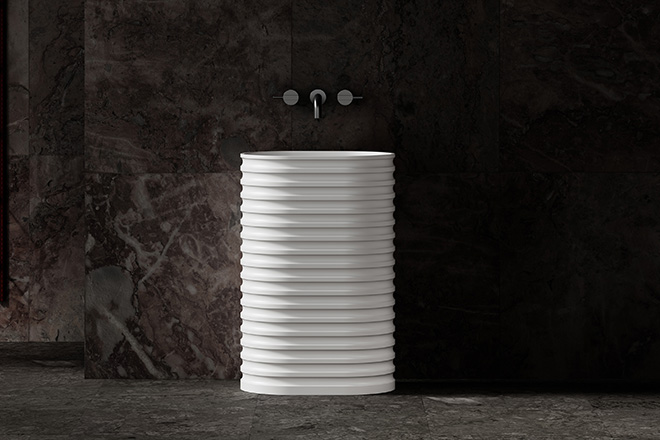
- Pedestal / freestanding transparent basin systems Typically resin-based or resin-stone based. Used when projects require a “monolithic” look and plumbing concealment within the pedestal body. Coordination focuses on floor/wall outlet positions, service access, and anchoring provisions.
- Limited undermount Less common for transparent basins due to edge visibility and bonding/seal considerations. When used, documentation should include edge finishing requirements, underside geometry, and a defined adhesive/sealant specification compatible with both basin material and countertop.
Form factors and dimensional conventions (round/oval/rectangular; depth bands)
Common form factors follow standard vessel conventions:
- Round: typically Ø380–Ø500 mm; bowl depth often 120–160 mm
- Oval: typically 450–550 mm length × 320–400 mm width; depth 120–160 mm
- Rectangular: typically 480–600 mm length × 340–420 mm width; depth 110–160 mm
For project planning, the dimensions that most affect performance are:
- internal bowl depth (splash control, usable volume)
- rim width (seal contact area and handling robustness)
- deck footprint (countertop reinforcement and clearances to backsplash/walls)
- drain opening position and diameter (drain selection and code requirements)
Finish and appearance options: clear, tinted, two-tone, patterned transparency
Transparent products are specified by optical attributes that need measurable control:
- Clear: highest visibility of drain/trap; requires the most attention to plumbing finish coordination and cleaning residue control.
- Tinted (single color): reduces visibility of water spotting and minor scuffs; common for hospitality palettes.
- Two-tone / gradient / patterned transparency: requires stricter lot control (color and pattern repeatability). This category is often positioned as designer glass-like sinks due to its optical depth and light behavior.
- Textured internal/external surfaces: can mask minor abrasions but may increase cleaning effort; specify which surfaces are polished vs textured.
These products are frequently used as boutique bathroom
sinks in premium wash areas, but the project success depends on disciplined control of color, clarity, and surface finish across production lots.
Structured element: selection matrix by typology vs application constraints
| Typology |
Key constraints to verify |
Typical best-fit applications |
Procurement risk to manage |
| Above-counter vessel (glass) |
Spout reach/splash, rim flatness, impact risk at rim edge |
Hospitality guest rooms, office executive washrooms |
Transit damage, edge chipping, optical distortion acceptance criteria |
| Above-counter vessel (clear resin) |
Scratch visibility, UV stability, chemical resistance |
Multi-unit residential, hospitality where housekeeping chemicals are aggressive |
Yellowing/opacity drift, micro-scratches under lighting |
| Pedestal/freestanding (resin/resin-stone) |
Plumbing concealment geometry, anchoring, access panels |
Retail/F&B, lobby washrooms |
Service access, field tolerance to wall/floor outlets |
| Limited undermount (select models) |
Bond line visibility, underside finishing, sealant compatibility |
Controlled environments with consistent countertop fabrication |
Higher installation coordination and rejection risk |
Materials engineering and performance characteristics
When evaluating transparent sinks wholesale, material selection is as critical as shape and installation type. Different transparent sink materials not only define the aesthetic clarity and color but also determine durability, chemical resistance, and long-term performance. Understanding these engineering and performance characteristics upfront ensures the right balance between visual appeal, maintenance, and safety for each project.
Tempered glass basins: thickness ranges, edge finishing, impact/thermal behavior
For transparent basins in glass, the primary engineering variables are glass thickness, tempering quality, and edge finishing:
- Typical thickness range: ~8–12 mm for many vessel designs (model-dependent).
- Edge finishing: polished and radiused edges improve handling safety and reduce crack initiation risk; specify allowable edge waviness and chip size limits.
- Impact behavior: glass is hard and chemical resistant but is sensitive to point impacts at edges. In high-traffic commercial washrooms, edge protection during construction and controlled handling procedures reduce site breakage.
- Thermal behavior: tempered glass generally performs well against moderate temperature swings, but thermal-shock performance must be specified based on project conditions (hot water use patterns, cleaning practices, ambient temperature).
Specification note: treat “tempered” as a process claim that should be supported by defined quality records and a consistent break-pattern requirement appropriate for sanitaryware applications.
Clear resin / resin-stone / solid-surface clear variants: UV stability and yellowing risk
Clear resin basins and clear resin-stone composites offer broader shape freedom and, in pedestal formats, better opportunities to conceal plumbing. Key performance points:
- UV stability: transparency can shift over time (yellowing or haze) depending on resin chemistry, stabilizer package, and exposure. Specify acceptable color shift over an agreed evaluation period and define storage/installation exposure assumptions (direct sunlight vs controlled interior lighting).
- Surface hardness and scratch visibility: resin systems can show micro-abrasions more readily under directional lighting. The material may be serviceable through professional refinishing in some systems, but procurement should focus on selecting a resin formulation and surface finish that matches the maintenance plan.
- Creep and dimensional stability: for larger pedestal components, verify long-term dimensional stability and anchoring strategy to avoid rocking.
Chemical resistance and stain performance (commercial cleaning agents compatibility)
Transparent surfaces make residue and spotting more visible; therefore chemical compatibility must be treated as a performance requirement, not an afterthought.
Project framing for maintenance of shine: “shine retention” should be specified as a combination of (1) surface gloss level at acceptance, (2) allowable gloss change after defined cleaning cycles, and (3) prohibition of abrasive pads/powders in the operations manual. This is a controls-and-chemistry issue, not a consumer polishing issue.
Structured element: comparative table—glass vs resin vs resin-stone trade-offs
| Attribute |
Tempered glass |
Clear resin basins |
Clear resin-stone composites |
| Optical clarity |
High; depends on inclusions/distortion control |
High to medium; can haze if formulation/process varies |
Medium; often slightly diffused due to filler content |
| Scratch perception |
Scratches less frequent but highly visible if present |
Micro-scratches more common; visibility depends on gloss and lighting |
Better scratch masking; depends on finish |
| Impact risk |
Higher at edges; brittle failure mode |
Better resilience to minor knocks; may dent/scuff |
Improved stiffness; edge damage still possible |
| Chemical resistance |
Strong baseline |
Must be verified by chemistry and cleaning regimen |
Generally robust; verify disinfectant compatibility |
| UV/yellowing risk |
Low for the substrate |
Must be specified and tested |
Lower than pure clear resin, but verify |
| Best-fit use |
Controlled environments; premium vessel installations |
Mixed-use projects needing color flexibility |
Higher-traffic areas needing stability and stiffness |
Dimensional specifications, tolerances, and documentation requirements
When sourcing transparent sinks wholesale, precise dimensional control is just as important as material performance. Even a beautifully engineered glass or resin basin can lead to site issues if rim widths, bowl depths, or drain positions are not properly specified. Clear documentation of dimensions, tolerances, and handling requirements ensures that each unit integrates seamlessly with cabinetry, faucets, and countertops.
Critical dimensions: rim, bowl depth, deck footprint, center drain opening sizes
For transparent sink procurement, the most common causes of site nonconformance are mismatched interfaces (faucet reach, drain fit, countertop clearance). Submittals should define:
- Overall dimensions (L × W × H)
- Internal bowl depth (from rim datum to lowest point)
- Rim width and rim flat seating band (critical for seal integrity and stability)
- Deck footprint / contact patch (the true load-bearing area on the counter)
- Drain opening: diameter and tolerances (commonly aligned to standard waste fittings; confirm whether the basin requires a decorative oversized drain flange)
- Drain location: center or offset, with coordinates from datum edges
- Overflow: none vs integrated overflow (and its geometry), aligned with drain selection and local code expectations
Tolerances and flatness: seating stability on countertops and seal performance
Transparent vessel basins often rely on a thin seating interface. Specify:
Mass/handling data: unit weight, packaging size, and site handling constraints
Professional coordination requires accurate logistics data:
- Net weight (per unit) and gross weight (with packaging) for manual handling planning.
- Pack dimensions and stacking limits for warehouse and site storage.
- Handling constraints: transparent edges and polished surfaces are sensitive to abrasion; packaging design and site staging rules should be aligned to reduce rework and rejects.
Visual: annotated dimensioned drawing checklist for submittals
Visual (for submittals): an annotated drawing checklist including:
- plan view with rim OD/ID, drain center coordinates
- section view with rim seating band width, bowl depth, wall thickness (glass/resin)
- note for overflow presence/absence and corresponding drain requirement
- countertop clearance envelope and recommended spout-to-rim target range
- weight, packaging, and handling icons (non-normative)
Standards, certifications, and regulatory acceptance
For transparent sinks wholesale, precise dimensions and handling data are only part of the procurement equation. Ensuring regulatory acceptance and adherence to recognized standards is equally critical, as compliance affects both legal installation and long-term project reliability. Early alignment on certifications, testing, and documentation helps avoid costly substitutions or approval delays on site.
Plumbing compliance pathways: cUPC/IAPMO/CSA considerations by market
Acceptance requirements vary by jurisdiction and project type. Procurement teams should confirm early whether the basin must be:
- listed/certified to a recognized plumbing product standard (common in North America via cUPC pathways)
- supported by third-party testing documentation
- accompanied by traceable marking and factory identification
If the basin itself is not required to carry a listing in a target market, the complete assembly (drain, overflow function, trap compatibility) may still need to comply with local plumbing code interpretations. Document the compliance approach in the bid package to avoid late-stage substitutions.
Material safety and building requirements: lead content, REACH/RoHS where applicable
Transparent basins typically have minimal metal content, but projects may still require:
- REACH declarations (substances of very high concern reporting obligations)
- RoHS declarations (particularly for projects with harmonized material compliance requirements)
- documentation of material composition sufficient for project environmental submittals
Performance references to cite: applicable ASTM/ASME test methods (where relevant)
Where project teams need defensible performance language, reference recognized test frameworks as applicable to the product’s scope. Based on
ASTM standards, impact resistance, strength characterization, and chemical resistance methods provide measurable, repeatable criteria, while
ASME guidance supports dimensional verification and sampling plans.
The key is to specify what will be tested, how samples are selected, and what constitutes a pass/fail, rather than relying on generic “durable” statements.
Documentation set: test reports, certificates, factory QA records, warranty terms
A commercial submittal package for transparent sinks should typically include:
- certified drawings with revision control
- declared material and finish specification
- compliance certificates where required (or a written compliance pathway statement)
- test reports relevant to project risk (impact, thermal shock, chemical resistance)
- factory QA summary (inspection points, sampling plan)
- warranty terms aligned to commercial use (scope, exclusions, claims process)
System compatibility and integration with bathroom assemblies
When specifying transparent sinks wholesale, compliance and certification alone are not enough for a successful installation. Equally important is how the basin interacts with faucets, drains, countertops, and surrounding bathroom assemblies. Early coordination of these system interfaces ensures proper splash control, plumbing concealment, and overall operational harmony, preventing site conflicts and reducing rework.
Faucet and spout reach coordination: splash control, spout-to-rim geometry
Transparent vessel basins are sensitive to splash behavior because the bowl walls are often smooth and steep. Coordination items:
- define a spout outlet position relative to the drain center (horizontal) and rim (vertical drop)
- verify spout reach so water lands in the bowl’s functional zone, not on the rim
- coordinate flow rate and aeration expectations with the washroom’s usage profile
For specification packages, treat splash control as a geometry problem: spout projection, outlet angle, bowl depth, and drain location must be coherent.
Drain/overflow configurations: non-overflow vs overflow drains; code coordination
Transparent vessel sinks are commonly non-overflow. This affects:
- drain body selection (non-overflow drain vs overflow-compatible drain)
- local code interpretations for public washrooms (some jurisdictions or project standards prefer/require overflow management in certain applications)
Procurement should standardize the drain type across a project where possible to reduce spares complexity. If overflows are used, require clear documentation of overflow channel geometry and cleaning access strategy.
Countertop and mounting interface: cutout conventions, support rings, sealant specs
Integration requirements to define in drawings/specs:
- cutout diameter/shape for the drain penetration (plus clearance tolerance)
- support method: direct rim seating vs defined support ring/plate for certain models
- sealant compatibility with glass/resin surface energy and countertop material; define non-staining, non-migrating sealants to avoid visible halo effects on transparent rims
Visual: system relationship diagram (basin–drain–trap–counter–faucet clearances)
Visual (coordination diagram): show minimum clearances and interfaces:
- basin wall to faucet body clearance
- drain stack-up (strainer + body + gasket + counter thickness + tailpiece)
- trap envelope and access zone
- backsplash distance and cleaning access clearance
How to hide plumbing with a clear
sink (project approach): Because transparency makes traps and shutoffs visually prominent, concealment is typically achieved through one of the following design-coordination strategies:
- use a vanity/cabinet with sufficient depth and an access panel strategy
- specify a pedestal/freestanding transparent basin with an internal chase
- coordinate wall outlet positions so the trap sits close to the wall plane and aligns with a discreet cover panel or architectural cladding These are architectural and MEP coordination decisions; they should be resolved at layout stage to avoid ad-hoc site solutions that compromise serviceability.
Manufacturing process controls and quality assurance (QA/QC)
Once system interfaces and installation requirements are defined, attention must turn to how transparent sinks are manufactured and verified. Effective manufacturing process controls and quality assurance ensure that the basins arriving on site meet dimensional, optical, and structural expectations, reducing risk of installation issues or post-delivery defects.
Glass tempering and finishing controls: edge strength, inclusions, optical distortion
Key production controls for tempered glass basins:
- raw glass selection and inspection for inclusions and refractive defects
- tempering cycle control to achieve consistent stress profiles
- edge processing (polish quality, radius consistency) to reduce crack initiation
- optical inspection under controlled lighting to grade distortion and visual waves
Transparent products should be inspected under defined lux levels and viewing distances to avoid subjective acceptance disputes.
Resin casting/curing controls: bubbles, voids, surface hardness, color consistency
For clear resin basins, the most common quality risks are visual:
- micro-bubbles, voids, or flow lines visible under directional light
- local haze from incomplete cure or contamination
- color drift between lots for tinted products (especially in colorful transparent sinks)
Controls typically include:
- vacuum/degassing and controlled pour parameters (process-defined, not site-defined)
- cure schedule verification and post-cure stability checks
- standardized pigment dosing and batch records
- surface hardness and gloss verification for each lot
Inspection plan: AQL levels, dimensional sampling, and appearance grading criteria
For wholesale programs, align on:
Structured element: QC checklist for pre-shipment inspection (PSI) and lot release
PSI / lot release checklist (typical):
Sourcing, commercial terms, and risk management for bulk procurement
With robust manufacturing and quality controls in place, the next focus is how transparent sinks wholesale programs are sourced and delivered. Efficient procurement strategies, clear commercial terms, and proactive risk management ensure that the high-quality basins specified and inspected in production reach the project site intact, on time, and within agreed specifications.
MOQ and assortment strategy: trial lots vs scale orders; mixed-model feasibility
Transparent sinks wholesale programs often balance design variety with production efficiency. Common procurement approaches:
- trial lots to validate optical consistency, drain compatibility, and packaging integrity
- scale orders with reduced model count to stabilize yield and lot uniformity
- mixed-model containers when the supplier can control labeling, separation, and traceability at pallet level
For multi-phase projects, include a repeatability clause: color/clarity targets, finish control method, and a commitment to maintain tooling and process parameters for the project duration.
Lead time drivers: mold development, color/finish changes, and capacity constraints
Lead time is typically affected by:
- tooling/mold development for new forms (resin and resin-stone)
- additional cycle time for special finishes (two-tone, patterns, texture + polish combinations)
- QA gating for optical grading (transparent products have higher visual rejection risk)
To reduce schedule exposure, align early on “locked” attributes: rim geometry, drain interface, and color targets.
Packaging and transport specs: drop-test expectations, carton/foam design, palletization
Damage risk is a primary cost driver for glass basins and a meaningful risk for polished resin surfaces. Procurement documentation should define:
- minimum carton grade and internal foam density requirements
- rim/edge protection strategy (corner blocks and isolation from carton walls)
- palletization limits (stack height, layer count, edge crush constraints)
- drop/impact test expectations for packaged goods (method and acceptance)
Incoterms and claims handling: damage rates, replacement policy, and traceability
For transparent basins, claims handling must be structured because disputes often relate to appearance grading. Define:
- inspection window at receiving
- photo evidence requirements (outer carton + inner packaging + product defect)
- lot/serial traceability rules
- replacement/credit mechanism and timing
- agreed threshold for transit damage rates and corrective actions (packaging redesign, carrier handling changes)
Application scenarios and specification decision frameworks
Once procurement, logistics, and risk management are addressed, the focus shifts to how transparent sinks perform in real-world applications. Considering the specific operational demands of hospitality, public, and high-end residential projects helps define material selection, durability targets, and housekeeping requirements, ensuring that the chosen basins meet both aesthetic and functional expectations throughout their lifecycle.
Hospitality guest bathrooms: durability targets, housekeeping chemical exposure, spares
Hospitality programs should specify around:
- chemical exposure profile (disinfection frequency and chemistry class)
- spare unit strategy (typical percentage by phase) to prevent color mismatch later
- standardization of drain and trap finishes to avoid visible inconsistency through clear bowls
How to maintain shine on transparent basins (operations requirement): Define a housekeeping specification centered on non-abrasive tools and neutral-pH cleaners, with periodic inspection for water-spotting and mineral scale. This is particularly important for clear resin basins where micro-abrasion reduces perceived clarity under downlighting.
Office/public washrooms: vandal resistance considerations and lifecycle replacement planning
For higher-traffic public washrooms, the key question is durability rather than appearance variety.
Are transparent sinks durable for public restrooms (spec answer): They can be durable when specified correctly, but the risk profile differs by material:
- tempered glass: strong surface hardness and chemical resistance, but higher consequence of edge impact; specify edge radii, packaging controls, and consider whether the location has elevated vandal/impact risk.
- resin-stone composites: generally better resistance to minor knocks and offer thicker sections; often preferred where accidental impacts are more likely.
Lifecycle planning should include:
- standardized model selection to simplify replacement
- a defined acceptance standard for appearance so replacements match installed units under the same lighting
High-end residential multi-unit: consistency across phases, alternates, and VE pathways
Multi-unit projects often face phased purchasing and substitution risk. Control methods include:
- locking a defined optical target (clear/tint level, haze allowance)
- defining acceptable alternates (e.g., glass vessel alternate to resin vessel) with clearly stated impacts on spout geometry, drain selection, and cleaning regime
- establishing a value-engineering pathway that protects interfaces (drain position, footprint, spout-to-bowl relationship) even if material changes
Structured element: decision framework—spec priorities by application (cost/risk/aesthetics)
| Application |
Primary spec priorities |
Typical material bias |
Key coordination items |
| Hospitality guest bathrooms |
chemical compatibility, spares consistency, packaging integrity |
glass or resin (tint often reduces spotting visibility) |
drain standardization, spout geometry, replacement matching |
| Public washrooms |
impact/vandal resistance, serviceability |
resin-stone or robust resin systems |
concealment/service access, anchoring, damage replacement plan |
| Retail/F&B feature wash areas |
optical quality, lighting interaction, brand-neutral palette control |
glass for clarity or tinted resin for color control |
lighting mockup, glare/scratch visibility, cleaning protocol |
| Multi-unit (high-end) |
phase-to-phase repeatability, alternates control |
whichever is most repeatable in supply chain |
locked dimensions, documentation discipline, lot traceability |
Do transparent resin sinks scratch easily (spec framing): Resin surfaces can show micro-scratches sooner than glass under abrasive cleaning or contact with hard particles. Manage this by specifying surface hardness targets, prohibiting abrasive cleaning methods in the O&M documentation, and selecting finishes (tint/texture) that reduce scratch visibility under project lighting.
What colors are available for resin sinks (procurement framing): Color availability is primarily a function of pigment systems and clarity requirements. From a procurement standpoint, require (1) a defined color reference method, (2) lot-to-lot color tolerance, and (3) a control plan for mixed-batch production so phased deliveries remain consistent.
Are these sinks heat resistant (project framing): Specify heat and thermal-shock expectations based on real use: hot water discharge, ambient conditions, and cleaning cycles. Tempered glass generally tolerates higher short-term temperature differentials than many clear resin systems, while resin performance depends on formulation and should be validated by defined test conditions.
FAQs
Are transparent sinks durable for public restrooms?
Yes, they can be, but durability depends heavily on the material and the environment. Tempered glass is very hard and chemically resistant, so it stands up well to frequent cleaning and disinfectants, though edges remain vulnerable to impact. Resin or resin-stone sinks are more forgiving against minor knocks and accidental bumps, making them suitable for high-traffic areas. The key is to match the sink material to expected use, define clear appearance and performance standards, and ensure edge protection or proper handling during installation. Standardizing models across the restroom also makes maintenance and replacement easier.
How do you hide plumbing with a clear sink?
Because transparent sinks show everything underneath, hiding plumbing needs planning from the start. You can use a vanity cabinet with enough depth and a proper access panel, or a pedestal basin with an internal chase to conceal the trap and shutoffs. Wall outlet placement can also help keep the piping close to the wall, allowing a discreet cover panel or architectural cladding to hide it. The trick is to coordinate these decisions during the layout stage so service access remains practical and cleaning is still easy, avoiding any last-minute on-site fixes that might compromise functionality or aesthetics.
Do transparent resin sinks scratch easily?
Resin surfaces are generally softer than glass, so they can show micro-scratches sooner, especially under abrasive cleaning or contact with hard objects. However, the right formulation and surface finish can minimize visible scratching, and lightly tinted or textured finishes help hide minor marks. Specifying proper cleaning methods—avoiding harsh pads or powders—is crucial. In commercial or hospitality projects, you also want to plan a maintenance schedule that includes periodic inspection and touch-ups if needed. Overall, they are serviceable, but understanding their scratch sensitivity upfront ensures long-term appearance quality.
What colors are available for resin sinks?
Resin sinks offer a wide palette of options, from clear and neutral tones to vibrant tints or semi-transparent shades. The actual range is governed by the pigment system and clarity requirements—darker or heavily pigmented colors may reduce transparency, while lighter tints keep the see-through effect. For large or phased projects, lot-to-lot color consistency must be controlled, and reference samples should be retained to ensure future deliveries match the original batch. Defining an acceptable color tolerance and a clear control method during procurement prevents surprises and keeps the installed look uniform across all units.
Are these sinks heat resistant?
Tempered glass sinks handle short-term hot water exposure and moderate temperature swings very well, making them suitable for typical commercial or residential use. Clear resin and resin-stone sinks are more sensitive, so heat resistance depends on the formulation and curing process. They can tolerate normal bathroom temperatures, but sudden thermal shocks or direct exposure to boiling water may cause warping or clouding over time. For both materials, it’s best to specify thermal performance expectations, consider ambient temperature and cleaning routines, and validate the sinks with a test protocol if high-temperature use is anticipated.
How to maintain the shine on transparent basins?
Maintaining shine is mostly about gentle care and proper cleaning routines. Use neutral-pH cleaners, soft cloths, or non-abrasive sponges, and avoid powders or harsh pads that can scratch the surface. Regular removal of water spots and mineral deposits keeps clarity high, especially for resin sinks where micro-abrasions are more noticeable under directional lighting. For commercial or hospitality settings, include clear housekeeping instructions in the operations manual, define inspection intervals, and emphasize methods that protect both optical clarity and surface gloss. This approach ensures basins look their best throughout their service life.
References