Matte white
solid surface bathtubs have become a standard specification item in commercial hospitality and multi-unit residential projects where finish consistency, cleaning protocols, and field coordination drive decision-making. Unlike decorative consumer-facing narratives, the commercial specification route treats these tubs as engineered fixtures—defined by their material platform, dimensional controls, finish metrics, and compliance pathway.
Within this scope, a matte white solid surface bathtub refers to a freestanding, one-piece soaking unit manufactured from mineral-filled resin composites with a non-porous matte surface engineered for color stability, gloss control, and in-service repairability. Specification intent focuses on verifying material family, performance expectations, rough-in compatibility, weight and structural assumptions, finish acceptance criteria, and certification requirements across different jurisdictions.
Procurement and design teams typically align decisions early around rough-in standardization, floor loading, finish inspection criteria, and delivery/lot controls for phased projects. Because matte white finishes are sensitive to batch variation and lighting, the specification must define measurable performance attributes—rather than aesthetic descriptors—to reduce ambiguity at submittal review, factory QA, and site acceptance stages. The following sections outline the applicable scope, definitions, material platforms, finish and compliance criteria, and the interfaces that influence commercial deployment and long-term operations.
Matte white solid surface bathtub: scope and spec intent
Commercial matte tubs sit at the intersection of material engineering, plumbing coordination, and finish standardization. In specification language, clarity on scope and intent determines what is included, what is excluded, and which compliance pathways are expected by the Authority Having Jurisdiction. The following scope statement defines the fixture type, boundary conditions, and certification references that procurement and design teams rely on for bid leveling and submittal review.
Definition: freestanding one-piece solid surface soaking tub (matte white)
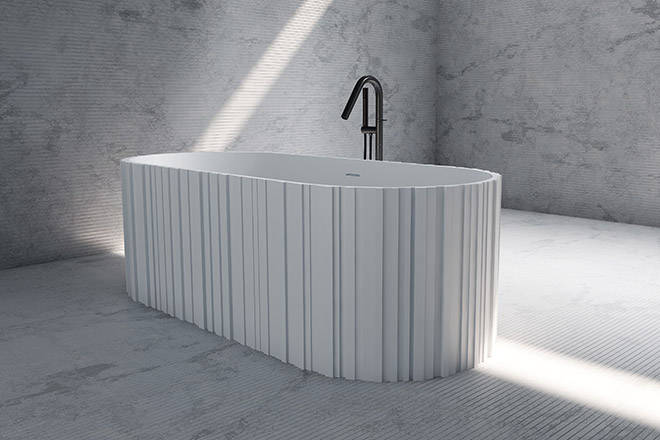
A Matte white solid surface bathtub in commercial specification typically refers to a freestanding, one-piece, non-porous composite soaking tub manufactured by casting or molding a mineral-filled resin system into a single monolithic shell. The matte white finish is engineered into the surface layer (or the full-body material, depending on formulation) to deliver controlled gloss, color consistency, and repairable surface performance.
Within a complete bathroom product system, the tub specification must be coordinated with:
- rough-in locations (waste, overflow, water supply strategy)
- waterproofing scope at floor/wall junctions
- flooring substrate and structural design loads
- faucet/spout system selection (wall-mount vs floor-mount)
- finish coordination across adjacent solid surface, ceramic, stone, and metalwork packages
Documentation-level responsibility mapping
Division of responsibility: Manufacturer supplies tub, surface finish, and integrated waste/overflow; excludes rough-in plumbing, floor waterproofing, and surrounding fixtures
Documentation mapping:
- Tub submittal: dimensioned drawings, finish targets, base footprint, drain/overflow template
- Plumbing rough-in: pipe centers, trap alignment, tailpiece compatibility
- Waterproofing details: floor/wall transition interface, sealant recommendations
Typical project decision points: rough-in, floor loading, lead time, finish expectations
For procurement and design teams, the highest-impact decisions are usually locked early:
- Rough-in standardization: center-drain vs end-drain affects trap positioning, access planning, and multi-unit repeatability.
- Floor loading and handling: solid surface and resin stone products carry higher dead loads than thin-wall acrylic; packaging and rigging constraints also affect site logistics.
- Lead time and batch control: matte white is sensitive to lot-to-lot variation under mixed lighting; staged deliveries require batch traceability.
- Finish expectations: matte white will show wear differently than gloss; acceptance criteria should be set for gloss level, color tolerance, and allowable touch-up/refinishing.
These considerations apply equally whether the purchase route is direct project supply or wholesale matte white tub programs through distributors.
Exclusions and boundary conditions: alcove/drop-in, whirlpool systems, site-fabricated surrounds
This scope addresses freestanding, one-piece soaking tubs only. The following are excluded because they introduce different standards, interfaces, and risk profiles:
- alcove, apron-front, and drop-in tubs requiring deck support
- whirlpool, air-jet, and pump-driven systems (electrical, access panels, service requirements)
- site-fabricated surrounds and integral tiled decks (separate waterproofing and substrate engineering scope)
Reference set: where to cite code authorities and certification bodies (IAPMO, ASME, CSA, CE)
Codes and listings vary by market and project type. Submittals should cite the relevant authority and listing pathway, commonly including:
- IAPMO for cUPC/cERTIFIED pathways (market dependent)
- ASME / CSA fixture standards as applicable for plumbing fixtures
- CE marking where required by jurisdiction and product scope (supported by the applicable harmonised standard and technical documentation)
Project specifications should reference the governing plumbing code in force and the listing/marking requirements accepted by the Authority Having Jurisdiction.
Material platform: solid surface, resin stone, and PMMA composites
Material selection in matte white solid surface bathtubs is not a monolithic category; the term “solid surface” spans multiple composite platforms with different resin chemistries, filler architectures, and performance profiles. From a specification standpoint, the material family determines finish behavior, thermal/acoustic characteristics, chemical compatibility, repairability, and the type of documentation that can be provided at submittal. The following distinctions clarify nomenclature, performance mechanisms, and documentation pathways for commercial projects.
Material families and nomenclature: resin stone/artificial stone vs PMMA/MMA + mineral fillers
“Solid surface” in bath applications is used broadly; procurement teams should confirm the exact material family because performance and processing controls differ.
Common families include:
- Resin stone / artificial stone (stone resin soaking tub): a mineral-filled resin composite (often high filler loading) cast into a one-piece shell. These are valued for stiffness, mass, and thermal damping.
- PMMA/MMA composite solid surface: acrylic resin systems (PMMA and/or MMA) combined with mineral fillers; these can be full-body or capped constructions depending on manufacturing method.
From a manufacturer-side evaluation, critical differentiators are filler type and loading, resin chemistry, cure control, and whether the product is full-body homogeneous or uses a surface layer engineered for finish and repair.
Non-porous performance: hygiene, stain resistance, and chemical resistance (ASTM/ISO reference points)
Commercial selection often prioritizes non-porous behavior to support hygiene protocols and reduce staining risk from oils, pigments, and hard-water residue. Non-porous performance is not a single claim; it is evidenced through:
- controlled water absorption behavior and surface continuity
- stain resistance screening against typical bathroom soils
- chemical resistance testing against cleaners/disinfectants used by facility operators
Commonly referenced test methods (selected based on project requirements) include chemical resistance and stain exposure methods such as
ASTM D543 and ASTM D1308, and plastics-related property standards where relevant. For healthcare or assisted living documentation packages, teams may also request antimicrobial test reports when additives are used (method and scope must be stated clearly; antimicrobial claims are jurisdiction-sensitive).
Commercial specification requires non-porous performance to be measurable and method-defined. Recommended numeric thresholds include:
- Water absorption: ≤0.05% by mass (ASTM D570)
- Stain resistance: No visible discoloration after 24h exposure to typical bathroom soils (ASTM D1308), classified as Pass/Conditional/Fail
- Chemical resistance: Resistance to acids, alkalis, and oxidizing disinfectants as per ASTM D543, with surface rating ≥ 4 (1 = severe attack, 5 = no effect) Acceptance categories should be explicitly documented in submittals, with the test method, exposure conditions, and classification referenced. For healthcare applications, antimicrobial additive performance must include method, scope, and jurisdiction-specific claim validation.
Thermal and acoustic behavior: heat retention and noise damping versus thin-wall acrylic
A luxury resin bathtub specified for hospitality frequently targets longer soak-time comfort and reduced sound transmission. Compared with thin-wall acrylic constructions, thick-section mineral-filled composites typically provide:
- higher thermal mass and slower heat loss (dependent on water volume, ambient conditions, and tub geometry)
- acoustic damping that reduces “drumming” noise during filling
These behaviors are not universal; they depend on wall thickness distribution, filler loading, and the stiffness of the base support. For multi-unit projects, thermal/acoustic preference should be balanced against weight, handling, and structural coordination.
Commercial guidance can define minimum and typical thresholds:
- Thermal retention: Thermal conductivity 0.25–0.35 W/m·K; heat loss <15% per hour under standard bath volume (ISO 10456)
- Acoustic damping: Sound Transmission Class (STC) 45–50 for filled tub, measured per ASTM E90 Submittals should report measured values and classification categories (e.g., Pass/Conditional) to verify consistency across multiple units.
What material documentation should be requested for commercial submittals (SDS/DoC/test reports)?
A complete submittal set for solid surface tubs should include, at minimum:
- Safety Data Sheet (SDS) for the supplied material system
- Declaration of Conformity (DoC) to the applicable listing/standard route, where claimed
- Material composition declaration (at least at a high level: resin family + mineral filler type; restricted substances statement where required)
- Test reports or third-party verification for the specific model family (not generic marketing statements)
- Care and chemical compatibility guidance intended for facility operations (cleaner/disinfectant categories, concentration limits, contact time guidance)
Matte white finish engineering and surface performance criteria
In commercial specification, a matte white finish is treated as a performance surface rather than an aesthetic descriptor. Acceptance depends on measurable gloss and color metrics, batch-to-batch traceability, and defined wear and cleanability expectations aligned with facility operations. The following criteria outline how matte surfaces are engineered, evaluated, and maintained across procurement, handover, and in-service phases.
Matte finish metrics: gloss level targets, color stability, and ΔE tolerances (ISO 2813 / ISO 11664 refs)
For freestanding matte tubs, a matte finish should be treated as a measurable specification, not a visual description. Two practical controls are:
- Gloss measurement at defined geometry, commonly evaluated using ISO 2813. Procurement documents should state the target gloss range and measurement angle.
- Color tolerance using colorimetry references such as ISO 11664 (method and illuminant/observer defined in the report). For matte white, tight ΔE tolerances help manage visible variation across batches and between replacement units.
Because matte surfaces scatter light, they can appear different under warm vs cool lighting. Project teams should evaluate control samples under representative lighting conditions (guestroom, corridor spill, daylight).
Matte finish numeric targets:
Gloss target: 3–6 GU at 60° per ISO 2813
Color tolerance: ΔE ≤2 per ISO 11664-4; measurements at 5–7 points across rim, interior, and apron surfaces
Batch control: Retain reference panels per production lot for lot-to-lot consistency
Measurement conditions: Standard D65 illuminant, 10° observer, inspection distance 0.5 m, consistent lighting angles This ensures visual uniformity, facilitates acceptance testing, and provides objective criteria for replacements or phased deliveries.
Scratch visibility and repairability: refinishing allowances and lifecycle expectations for high-traffic use
Matte white surfaces may show abrasion differently than gloss:
- fine scratches can reduce local reflectance and create “polished” spots rather than sharp scratch lines
- cleaning tools and housekeeping practices can create directional burnishing on horizontal rims
From a lifecycle perspective, solid surface and resin stone products are often specified because surface refinishing is feasible within defined limits. Specification language should clarify:
- whether refinishing is permitted on-site by trained trades
- acceptable abrasive grades and methods (planning-level only in project manual)
- maximum refinishing frequency before geometry or texture is affected (notably at rim edges)
In hospitality, aligning finish expectations with operations is often more decisive than selecting the lowest measured roughness at handover.
Cleanability constraints for facility operations: disinfectant compatibility and surface integrity (ASTM/ISO refs)
Facility teams typically use disinfectant chemistries that can stress polymer surfaces if concentration and dwell time are uncontrolled. Submittals should state compatibility guidance for:
- neutral to mildly alkaline cleaners
- oxidizing disinfectants and their concentration/contact limits
- solvent exposure restrictions (where applicable)
Rather than prescribing consumer cleaning products, the tub specification should require the manufacturer to provide a chemical compatibility statement tied to common active-ingredient categories, supported by testing where demanded. Chemical resistance and exposure testing is commonly aligned to methods such as ASTM D543 (chemical resistance) and project-specific protocols.
How does a matte white finish change scratch visibility and long-term appearance in hospitality?
In hospitality, matte white is often selected for controlled aesthetics under diffuse lighting, but it changes how wear presents:
- abrasion tends to “sheen up” high-contact areas (rim zones, entry side) rather than creating high-contrast scratch lines
- localized polishing can become the primary appearance risk if housekeeping uses abrasive pads or powders
- touch-up can blend well if the material is full-body and the refinishing method restores the original matte level
For long-term appearance retention, the key is aligning gloss targets, acceptance samples, and the housekeeping chemical/mechanical regimen during procurement—especially when the same model is deployed across multiple properties.
Dimensional standards, ergonomics, and load assumptions (spec table recommended)
Dimensional coordination for freestanding tubs is driven by both user ergonomics and building interfaces. In commercial planning, envelope dimensions define fit and circulation, while interior geometry determines usability, water volume, and filled load. Structural and tolerance controls then establish how the fixture integrates with flooring, traps, waterproofing, and FF&E. The following parameters outline the dimensional ranges, load assumptions, and coordinate references typically required for submittals and bid leveling.
Common size bands and usable bathing well geometry: length/width/depth ranges for one- and two-user soak
Commercial specification typically starts with envelope dimensions, then verifies usable interior geometry (bathing well length at shoulder/hip zones, backrest slope, and overflow-to-bottom depth). Market-typical bands for one-piece freestanding solid surface tubs include:
| Parameter |
Common band (project planning) |
Notes for specification |
| Overall length |
1400–1880 mm (55–74 in) |
Longer units can conflict with door swings, cleaning access, and FF&E clearances |
| Overall width |
750–1120 mm (29.5–44 in) |
Wider “two-user” geometry increases water volume and filled load |
| Overall height |
560–610 mm (22–24 in) |
Verify rim height vs user profile and accessibility intent |
| Internal soaking depth (to overflow) |
380–560 mm (15–22 in) |
A deeper well increases filled load and hot water demand |
| Rim thickness (visual) |
project-specific |
Thin rim aesthetics may require tighter QA for edge straightness and chip resistance |
Ergonomic selection should be documented with plan/section drawings showing the backrest angle and the functional bathing well, not only the external silhouette.
Mass and structural assumptions: net weight, filled load, and floor loading notes for structural coordination
Solid surface and resin stone tubs commonly have net weights in the 115–190 kg (250–415 lb) range, with gross shipping weights higher due to crating. For structural coordination, the controlling case is usually filled load, which includes:
- tub net weight
- water mass (dependent on usable volume and overflow height)
- occupant design load (project-defined)
Project documentation should require the manufacturer to declare:
- net weight per model
- nominal water capacity to overflow
- base footprint/contact points that transfer load to the floor
Structural design checks are the responsibility of the project structural engineer; the tub submittal should provide the data necessary for that verification rather than generic “reinforce floor” language.
Tolerances and interface control: critical dimensions at rim, base footprint, and drain/overflow locations
For multi-unit repeatability, tolerance control is often the deciding factor in reduced site rework. Critical controlled dimensions include:
- drain centerline location relative to tub center and base footprint datum
- overflow height from finished floor and from bathing well bottom
- base footprint and leveling contact points (to avoid rocking and to coordinate floor finishes)
- rim flatness and local thickness (affects faucet reach, splash control, and perceived quality)
Specifications should state dimensional tolerances and measurement datums (e.g., all dimensions from finished floor plane and tub centerline). When tubs are supplied as part of a standardized bathroom kit, tolerance stack-up with traps, tailpieces, and access allowances should be reviewed early.
Diagram suggestion: plan/section cut showing centerline, overflow height, and leveling contact points
A project-ready drawing set typically includes:
- plan view with centerline and drain/overflow offsets
- section showing rim height, overflow elevation, and bathing well depth
- underside view showing base footprint, contact pads, and any service clearance zones
These drawings should be issued with revision control and tied to model identification markings for site verification.
Drain/overflow configuration and plumbing system integration (compatibility matrix recommended)
Drain and overflow configuration is a critical coordination point in commercial freestanding tub specification. Decisions on center vs end drain, waste sizing, tailpiece materials, and faucet alignment directly affect rough-in standardization, service access, waterproofing interfaces, and long-term maintainability. The following guidance outlines design considerations and integration strategies for multi-unit programs and facility operations.
Drain location options: center vs end/right drain implications for rough-in and trap access
Drain selection impacts both coordination and long-term serviceability:
- Center drain supports left/right symmetry and can simplify standardized room layouts; it may reduce the need to mirror rough-ins across unit types.
- End/right (or end/left) drain can align with plumbing chases and reduce horizontal runs in some layouts, but it complicates standardization if units are mirrored.
In multi-unit programs, the drain location decision is often more about repeatable rough-in and access strategy than about aesthetics.
Waste/overflow interfaces: outlet sizing, tailpiece material expectations, and serviceability constraints
Most commercial freestanding tubs are paired with a waste/overflow assembly sized for typical bathtub drainage. The procurement package should define:
- waste outlet size and thread/connection standard expected by the plumbing system
- overflow style (integrated slot vs fitting) and service access expectations
- tailpiece and trap material requirements aligned to project corrosion and code needs
- access planning: how trap access is achieved without compromising waterproofing and finishes
Where the tub includes an integrated overflow path, verification of overflow performance and leak control should be part of the manufacturer QA evidence.
Faucet and spout coordination: wall-mount vs floor-mount clearances and splash control considerations
Matte white freestanding tubs are commonly paired with either:
- wall-mounted spout + valve (often preferred where wall backing and waterproofing can be controlled), or
- floor-mounted tub filler (requires precise floor penetration coordination and tolerance allowances)
Key coordination dimensions include spout reach to the tub interior, rim height relative to spout outlet, and water stream impact location to reduce splash and noise. Specification should require:
- a minimum clearance envelope between spout outlet and rim
- defined “wet zone” tolerance so water does not strike outside the bathing well during filling
- alignment responsibility (tub datum to finished wall and finished floor)
How should center-drain versus end-drain tubs be selected for standardized multi-unit rough-ins?
For standardized rough-ins across a portfolio:
- choose center-drain when unit layouts are mirrored or when the brand standard requires one rough-in for multiple room types; it reduces variation risk and simplifies spare parts stocking.
- choose end-drain when plumbing chases or slab penetrations are fixed to one side and repeating that side yields shorter runs and fewer offsets.
In both cases, the deciding factor is whether the selected option reduces field variability (trap placement, access, waterproofing penetrations) across the full unit count.
Compatibility matrix (planning-level)
| System interface |
Key variables to confirm |
Coordination output |
| Drain rough-in |
center vs end offset; datum to finished wall |
dimensioned rough-in sheet with tolerance |
| Trap access |
access zone under tub; method of access (adjacent panel vs ceiling below) |
access strategy note in coordination set |
| Overflow |
integrated slot vs fitting; test evidence |
QA report requirement + inspection criteria |
| Faucet strategy |
wall vs floor mount; spout reach and height |
spout envelope + clash check with tub rim |
| Waterproofing |
floor penetration detailing around filler/drain |
waterproofing scope and responsibility matrix |
Standards, certification pathways, and project compliance documentation
Compliance with recognized standards and certification pathways is a core component of commercial bathtub specification. Beyond material and dimensional requirements, project teams must ensure that listed marks, third-party verification, traceability, and jurisdiction-specific documentation are clearly defined. The following section outlines applicable plumbing product standards, marking expectations, and project-level compliance considerations to support procurement, QA, and field acceptance.
Applicable plumbing product standards and listing routes (ASME/IAPMO/CSA as applicable by market)
Bathtub acceptance is typically tied to jurisdictional plumbing code and recognized product standards. Depending on market, procurement may require:
- listing/marking under a recognized certification scheme (e.g., cUPC in North America)
- compliance with applicable fixture performance and material requirements (often referenced through ASME/CSA fixture standards)
- documentation for public-sector or regulated projects that specifies third-party certification rather than self-declaration
The procurement specification should state the exact listing mark and standard designation acceptable to the Authority Having Jurisdiction for the project location.
Replace general “certification” mentions with standard-level mapping:
- Standard designation: e.g., ASME A112.19.7 / CSA B45.5
- Applicable fixture category: freestanding solid surface bathtub
- Evidence expectations: recognized listing mark (cUPC, CSA, CE) with DoC and test reports
Merge duplicates from Reference set and PAA; clearly state which marks are acceptable per market
Submittals must include reference to the test standard, fixture category, and evidence artifacts for project acceptance
Marking and traceability requirements: model identification, batch tracking, and country-of-origin documentation
For commercial risk control, tubs should be delivered with:
- permanent model identification and production traceability (batch/lot code)
- packaging labels that match submittal model codes and finish codes
- country-of-origin documentation where required for customs and project compliance
- traceable QA records tied to the lot code (dimensional inspection and surface acceptance)
Traceability reduces dispute time during receiving inspection and enables targeted corrective action if a lot-specific issue arises.
Fire/smoke and chemical compliance considerations when required by jurisdiction (ASTM E84 / REACH/ROHS where specified)
While bathtubs are not always evaluated under building interior finish classifications, some jurisdictions or client standards request:
- surface burning characteristics reporting (commonly referenced through ASTM E84) for certain building types or project specifications
- restricted substances and chemical compliance documentation (e.g., REACH declarations, and RoHS where specified for components supplied with the fixture package)
These requirements should be treated as project-specific. If requested, the supplier should provide declarations and test evidence applicable to the supplied model and bill of materials.
Which certifications are typically required for commercial bathtub procurement (cUPC/CSA/CE), and when?
Typical triggers are:
- cUPC / recognized certification mark: often required when the local plumbing code requires listed fixtures and the inspector expects a recognized mark on the product.
- CSA/ASME referenced compliance: commonly used where fixture standards are cited in the plumbing code or project specification.
- CE marking: relevant where the project jurisdiction requires CE marking and the product falls under the applicable harmonised standard scope.
Procurement teams should confirm certification needs during schematic design to avoid late substitutions when inspection requirements surface.
Manufacturing process controls and quality assurance checkpoints
Consistent quality and reliable performance of matte white solid surface tubs depend on rigorous manufacturing process controls and systematic quality assurance. Beyond material selection, precision in molding, machining, finishing, and packaging ensures dimensional accuracy, surface uniformity, and long-term durability. The following section details critical process checkpoints, inspection protocols, and submittal expectations to support procurement, installation, and operational confidence.
One-piece molding/casting and post-processing: void control, CNC machining of drain/overflow, edge finishing
For a one-piece solid surface tub, manufacturing consistency is driven by process controls more than by nominal material category. Key controls include:
- resin-to-filler ratio control and mixing dispersion to minimize visible speckling or shade drift
- vacuum degassing or equivalent controls to reduce voids and pinholes
- controlled cure cycle to reduce internal stress and distortion
- precision machining of drain and overflow openings to hold location tolerances
- edge finishing standards at rim and overflow slot to prevent chipping and to maintain consistent tactile feel
A matte white appearance is particularly sensitive to micro-surface variation; finishing steps must be standardized to prevent localized gloss differences.
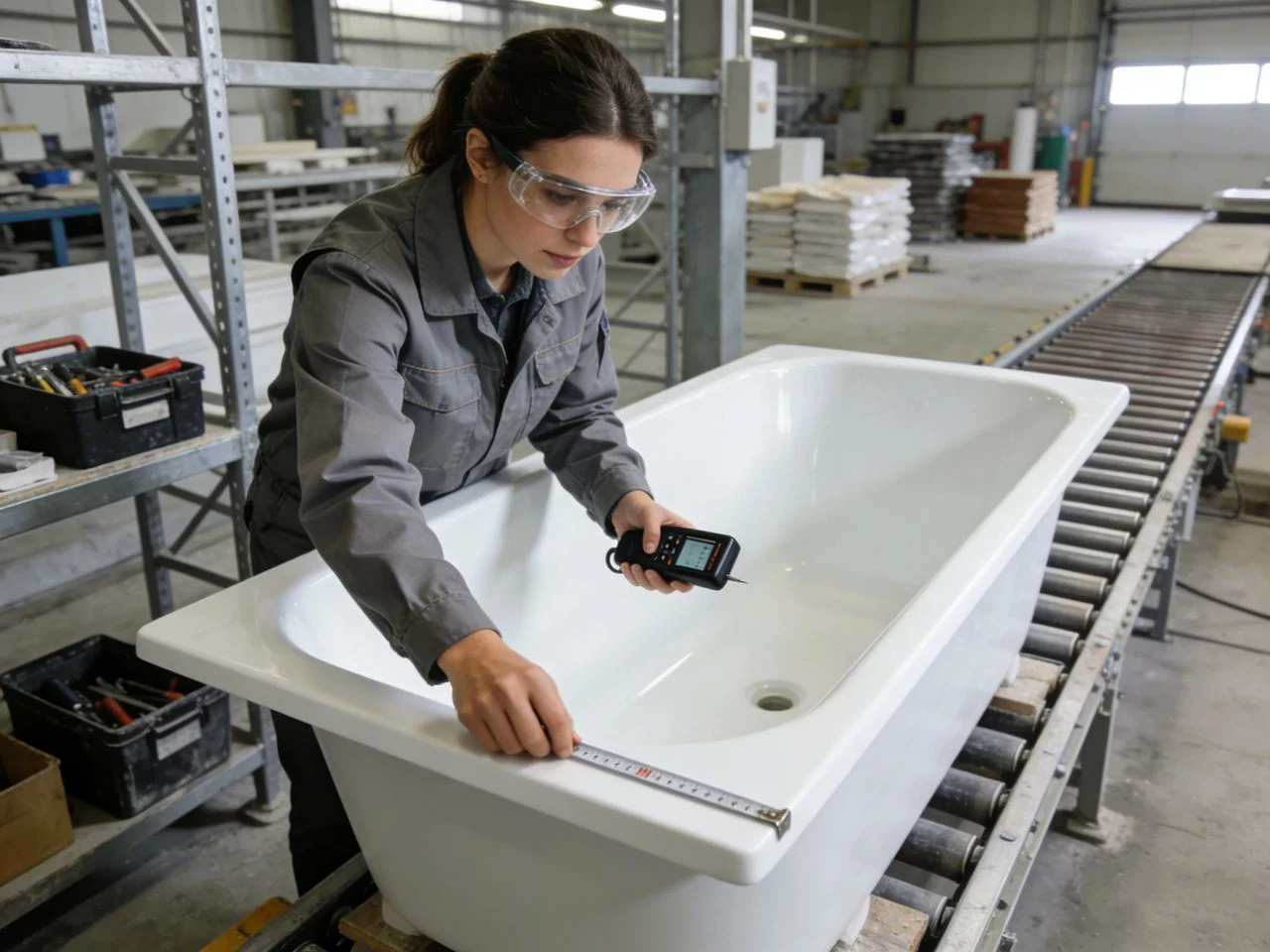
QA test regimen: dimensional inspection, surface defect criteria, leak/overflow validation, packaging drop/vibration
A commercially robust QA plan typically includes:
- dimensional inspection using defined datums and documented tolerances (not “nominal only”)
- surface acceptance criteria under controlled lighting: allowable inclusions, pinholes, matte uniformity, and edge condition
- water retention and leak validation at drain/overflow interfaces (as applicable to supplied configuration)
- packaging validation appropriate to export handling: drop/vibration tests or documented packaging standards, with corner/edge protection that prevents matte surface burnishing during transit
Receiving inspection criteria should mirror factory acceptance criteria to avoid subjective site rejections.
Numeric QA inspection tolerances and method-defined acceptance criteria:
Dimensional inspection: ±1.5 mm at all datums; use calipers or 3D scanning for verification
Surface defects: Pinholes ≤2/0.5 m², inclusions ≤1/0.5 m²; measured under 500–1000 lux illumination
Gloss/ΔE sampling: 5–7 points per unit; record values and compare against batch reference panel
Leak/overflow validation: 100% functional test for water retention and overflow performance This regimen should be documented, and deviations logged with corrective actions.
Finish and color consistency controls: lot-to-lot matching, pigment dispersion, and UV exposure checks
For matte white, the supply risk is often not “yellowing” in normal indoor use, but lot-to-lot variation and differential appearance under mixed lighting. Controls that improve predictability include:
- controlled pigment dispersion and recorded batch recipes
- retained control samples from each production lot
- periodic accelerated exposure checks where specified (method and acceptance criteria stated)
If a project includes phased procurement, the specification should request a batch reservation plan or documented approach to minimizing cross-lot variation.
Submittal package expectations: drawings, tolerances, material declaration, and inspection reports (templates suggested)
A complete manufacturer submittal package for professional review typically contains:
- dimensioned drawings (plan/section/underside) with datums and tolerances
- net weight, nominal water capacity to overflow, and base footprint/load transfer notes
- drain/overflow configuration sheet (connection expectations and rough-in dimensions)
- finish specification (gloss target range, color tolerance method)
- compliance documentation (listing marks, DoC, traceability approach)
- QA/inspection summary: inspection points and acceptance criteria that can be referenced during punch and closeout
Sourcing, customization, and commercial delivery constraints
Successful commercial procurement of matte white solid surface tubs requires careful planning around sourcing strategy, customization options, and delivery logistics. Decisions on stock versus project-specific models, lead times, and packaging considerations directly affect cost, quality, and on-site coordination. The following section outlines minimum order requirements, program controls, and commercial delivery constraints to support repeatable, risk-managed project execution.
Commercial terms: Incoterms, packaging ownership, damage claim window, spare parts for waste/overflow, warranty boundaries including chemical/housekeeping exposures
Phased rollout / spares: Finish matching controlled by batch reservation vs lot-matching protocol; submittal must define plan for replacements
MOQ and program structure: stock models vs project-specific tooling, cost drivers, and change control
Commercial supply commonly splits into:
- stock models with stable tooling and predictable lead times
- project-specific variants (dimensions, drain location, overflow style, matte level, accessory finish coordination)
Customization impacts cost through tooling, additional QC, and reduced production efficiency. For procurement control, any customization should be managed through:
- documented revision control (drawings and finish references)
- sample approval gates (finish panel and/or first-article tub)
- change control after approval (lead time and cost impact pre-agreed)
This applies whether units are purchased as a direct program or routed through a wholesale matte white tub channel.
Lead time and capacity planning: sample approval gates, production scheduling, and risk buffers for phased projects
For multi-phase developments, lead time risk is often driven by:
- sample approval cycle time (finish, drain location confirmation, packaging approval)
- production slotting and batch size
- transit time and import clearance
- damage replacement lead time (spares strategy)
Procurement schedules should include a risk buffer and a defined strategy for spare units and finish continuity across phases.
Logistics: palletization, gross weight planning, damage rate prevention, and receiving inspection criteria
Solid surface tubs ship with high gross weights and large dimensional footprints, which affects:
- container utilization and pallet patterns
- site receiving equipment requirements
- handling constraints through corridors/elevators
- damage prevention (edge protection is critical for matte surfaces)
Receiving inspection should be documented and limited to objective criteria:
- packaging condition and shock indicators (if used)
- visible surface damage under defined lighting
- verification of model code, drain configuration, and finish code against the approved submittal
Decision framework table: total installed risk (schedule/quality/compliance) vs unit cost for multi-site rollouts
For portfolio programs (hospitality groups, build-to-rent rollouts), selection should be based on total installed risk rather than unit price alone.
| Decision factor |
Lower unit cost risk |
Higher control / lower risk approach |
| Compliance |
unclear listing route; incomplete documentation |
verified listing/marking; complete DoC and traceability |
| Finish consistency |
variable matte level and shade between lots |
defined gloss + ΔE targets with retained lot samples |
| Dimensional repeatability |
broad tolerances; limited datum definitions |
controlled tolerances with datum-based drawings |
| Logistics |
minimal packaging validation |
validated packaging; defined receiving acceptance criteria |
| Schedule impact |
long replacement lead time; limited spares |
spare strategy + reserved capacity for replacements |
Application scenarios and specification selection framework
Selecting the right matte white solid surface tub requires aligning product attributes with the intended operational context. Hospitality, multi-family, and healthcare applications each impose distinct priorities for repeatability, finish retention, cleaning compatibility, and safety. The following framework guides specification decisions by linking use-case requirements to measurable design, installation, and procurement criteria.
Hospitality: repeatability, surface appearance retention, and housekeeping chemical compatibility
In hospitality, the bathtub is a visual and operational element. Selection priorities typically include:
- repeatable rough-in and model standardization across room types
- matte appearance retention under frequent cleaning cycles
- documented compatibility with housekeeping disinfectant categories
- clear refinishing allowances and damage repair pathways
Where matte vs gloss is debated for luxury positioning, the specification should treat it as an operations-driven finish decision: matte can control glare and highlight form, while gloss can show swirl marks differently and may change perceived cleanliness under certain lighting. The correct choice is the one that remains within the defined appearance tolerance after the property’s cleaning regimen.
Multi-family and build-to-rent: durability-to-cost optimization, standardization of rough-ins, warranty alignment
In multi-family and build-to-rent, key drivers are:
- unit-to-unit repeatability and reduced coordination time
- durability against tenant turnover cleaning practices
- defined warranty scope aligned to expected wear and facility responsibilities
- parts and service strategy (waste/overflow access and availability)
A matte white solid surface program can reduce visible patchiness from minor repairs, but only if the supplier provides consistent finish targets and the operator uses compatible cleaning methods.
Healthcare and assisted living: hygiene protocols, slip considerations, and infection-control documentation needs
For healthcare and assisted living, documentation depth increases:
- chemical compatibility statements must match disinfectant protocols
- infection-control documentation may be requested (method-based; avoid unsupported antibacterial claims)
- slip considerations and user safety may drive textured surfaces or accessories (project-specific and jurisdiction-dependent)
The tub itself must be evaluated within the broader bathroom risk assessment, including floor transitions, grab bar strategy (if applicable), and cleaning validation.
Selection checklist (project-ready): spec lock points, coordination holds, and acceptance criteria for punch/walkthroughs
A project-ready specification package should lock:
- model code, dimensions, drain location, and overflow configuration
- finish targets: gloss range (ISO 2813 reference) and color tolerance method (ISO 11664 reference)
- net weight, nominal water capacity, and base footprint/contact points
- certification/listing route and marking requirements
- submittal content requirements and revision control process
- receiving inspection criteria and surface acceptance standards
- operations documentation: chemical compatibility statement and approved refinishing policy (if allowed)
This checklist supports consistent procurement whether the unit is specified as a stone resin soaking tub, a PMMA composite solid surface model, or other mineral-filled composite under the “solid surface” umbrella.
FAQs
Is matte white or glossy finish better for luxury hotels?
Both finishes can work for high-end hospitality, but the matte white solid surface bathtub category has been trending in luxury boutique hotels because it creates a softer visual experience and pairs well with natural stone or brushed metal hardware. Glossy tubs still dominate standard rooms due to faster cleaning turnaround, but designers increasingly specify freestanding matte tubs in suites and lifestyle hotels to elevate the guest experience. When hotels source through a supplier offering wholesale matte white tub options, matte becomes more cost-feasible across multiple room types without sacrificing aesthetics or brand positioning.
How do you remove stains from a matte resin bathtub?
Matte resin tubs, especially stone resin soaking tub products, tend to resist water marks more effectively than high-gloss acrylic. Stains such as cosmetic residue, darker soap pigments, or towel dye transfer can usually be removed with mild abrasive cleaners and soft pads. Because the matte texture doesn’t rely on a clear gelcoat, the surface can be micro-polished to restore uniform tone—an advantage for hotels operating large FF&E assets and luxury bathrooms. For procurement teams evaluating luxury resin bathtub suppliers, it’s recommended to ask for care and maintenance documentation upfront to ensure compatibility with housekeeping SOP.
Does a matte finish scratch more easily than gloss?
Matte doesn’t necessarily scratch more easily, but micro-abrasions are more visible due to light diffusion on textured surfaces. With gloss, reflections hide fine scratches; with matte, sheen inconsistencies show faster. The benefit is that many matte white solid surface bathtub products are field-repairable, allowing surface refinishing without replacement. This reduces lifecycle replacement cost for hotel owners and operators compared to thin-coated
acrylic tubs. For large developments purchasing wholesale matte white tub units, scratch repairability can become a meaningful operational advantage.
How much weight can a solid surface bathtub hold?
Most stone resin soaking tub and solid-surface tubs are engineered for high static load—typically in the 300–400 kg (660–880 lbs) range including water and occupant. Some reinforced models exceed 500 kg under test conditions. Spa suites, villas, and branded residences frequently specify heavier luxury resin bathtub options due to larger dimensions and deeper soaking depths. Structural and MEP coordination is also important for freestanding matte tubs on suspended slabs to avoid floor deflection issues.
Does matte white resin turn yellow over time?
Yellowing depends heavily on the resin system. High-quality ATH + acrylic-based solid-surface materials maintain color stability far better than polyester blends when exposed to UV, chemical cleaners, and thermal cycling. For long-term hotel installations, it’s wise to select a matte white solid surface bathtub with documented QUV exposure test results and cleaning compatibility data to minimize yellowing risk over multi-year operation cycles.
How to maintain the soft-touch feel of a matte tub?
The soft-touch texture in matte resin tubs comes from micro-structure at the surface. To preserve it, avoid silicone-based polishes, wax coatings, or harsh acidic descalers that can alter the surface and unintentionally shift the finish to semi-gloss. Manufacturers of luxury resin bathtub products typically recommend neutral cleaners and periodic micro-sanding for long-term uniformity. For hotels, especially those sourcing wholesale matte white tub quantities for rollouts, having standardized cleaning SOP ensures the tactile finish stays consistent across rooms.
References