LED bathroom
mirrors used in commercial washrooms and multi-unit developments are integrated electrical products (mirror + luminaire + controls), not just decorative glass. For project procurement, the goal is repeatable lighting performance, controlled tolerances, and verifiable compliance across batches—especially when the mirror must coordinate with vanity depths, wall finishes, electrical rough-in positions, and broader bathroom product systems.
Scope Definitions And Project Decision Criteria For LED Bathroom Mirrors Wholesale
LED bathroom mirrors used in commercial washrooms and multi-unit developments are integrated electrical products (mirror + luminaire + controls), not just decorative glass. For project procurement, the goal is repeatable lighting performance, controlled tolerances, and verifiable compliance across batches—especially when the mirror must coordinate with vanity depths, wall finishes, electrical rough-in positions, and broader bathroom product systems.
Definition Of Backlit Vs Front-Lit LED Vanity Mirrors For Commercial Use
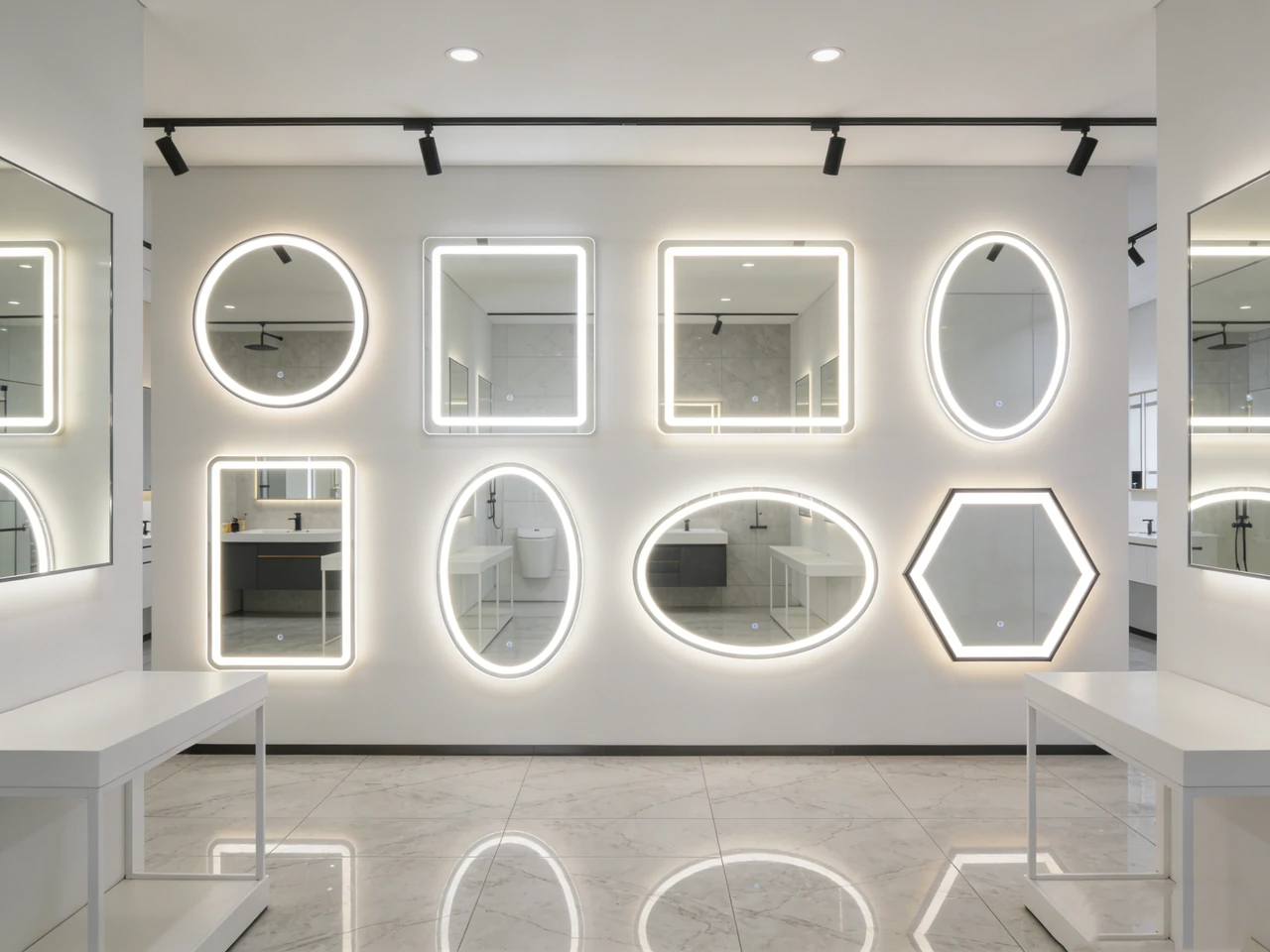
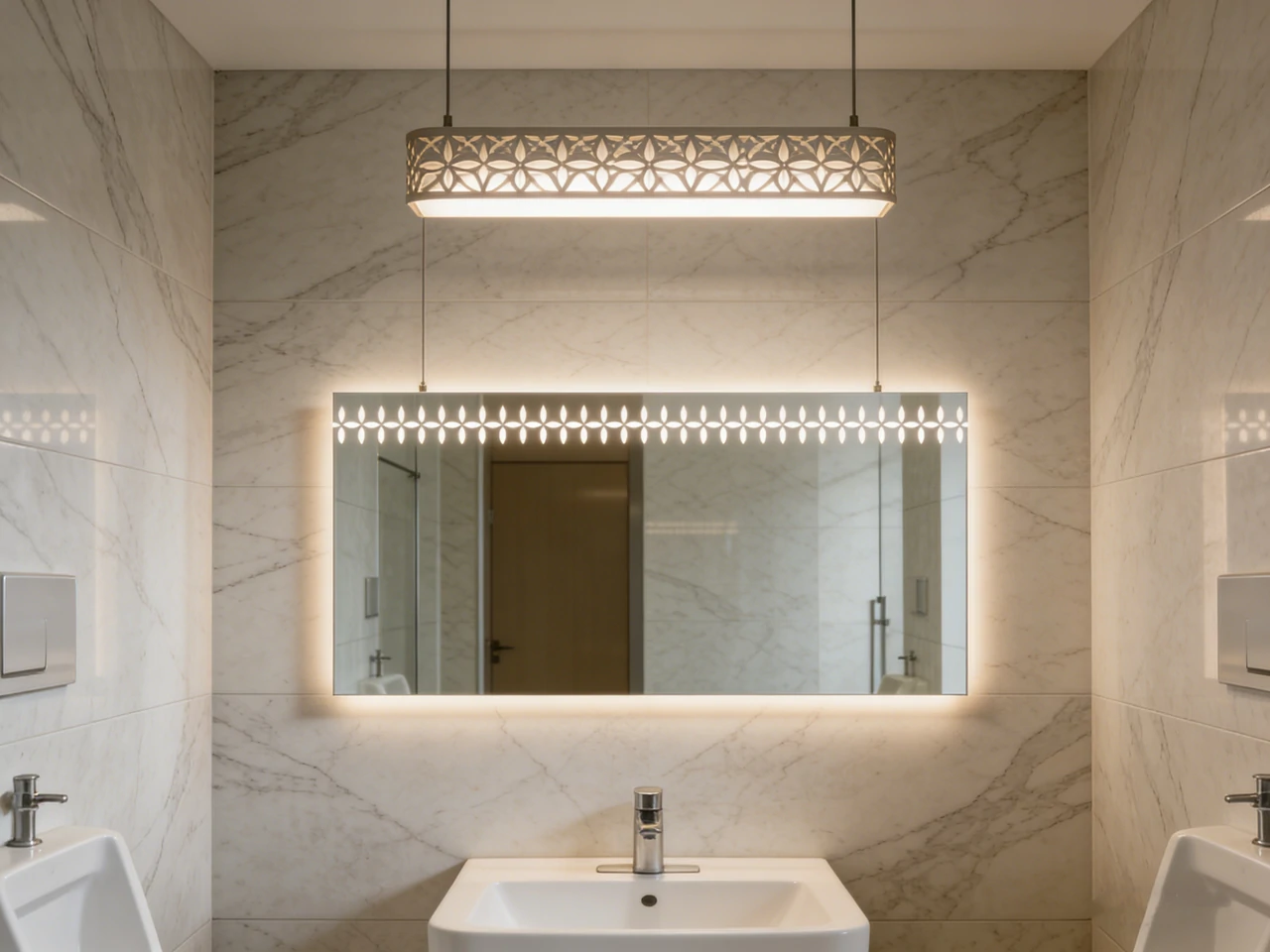
Backlit mirrors place the LED source behind the mirror plane and emit a perimeter “halo” onto the wall. Backlit hotel mirrors are often selected to reduce direct glare in guest bathrooms and to visually enlarge compact vanity zones. They depend strongly on wall reflectance, standoff distance, and diffuser geometry to achieve target vertical illuminance at the user’s face.
Front-lit mirrors emit light toward the user through a frosted window, etched pattern, or perimeter light channel. Front-lit designs generally deliver higher facial illuminance at the same wattage and are easier to photometrically specify, but require more disciplined glare control (diffuser quality, shielding angle, luminance limits).
For specification, treat backlit vs front-lit as an optical architecture decision affecting:
- target illuminance and uniformity at face height
- glare (UGR-style considerations, shielding angle, hot-spot control)
- wall condition sensitivity (paint sheen, tile reflectance, grout patterning)
- service access strategy (rear-driver access vs edge access)
Typical Procurement Scope For LED Bathroom Mirrors Wholesale
A wholesale mirror package suitable for project execution is normally scoped as a controlled kit, not an “as-shipped” retail item. Commercial buyers should define whether the supply includes:
- Mirror assembly: glass, backing, perimeter frame (if any), edge finishing, safety film (if required)
- LED system: LED strip/module type, diffuser/light window, thermal interface materials
- Driver/power unit: electrical ratings, efficiency, protection features, traceability labeling
- Controls: touch sensor, IR/wave sensor, wall-switch interface, dimming protocol (if any)
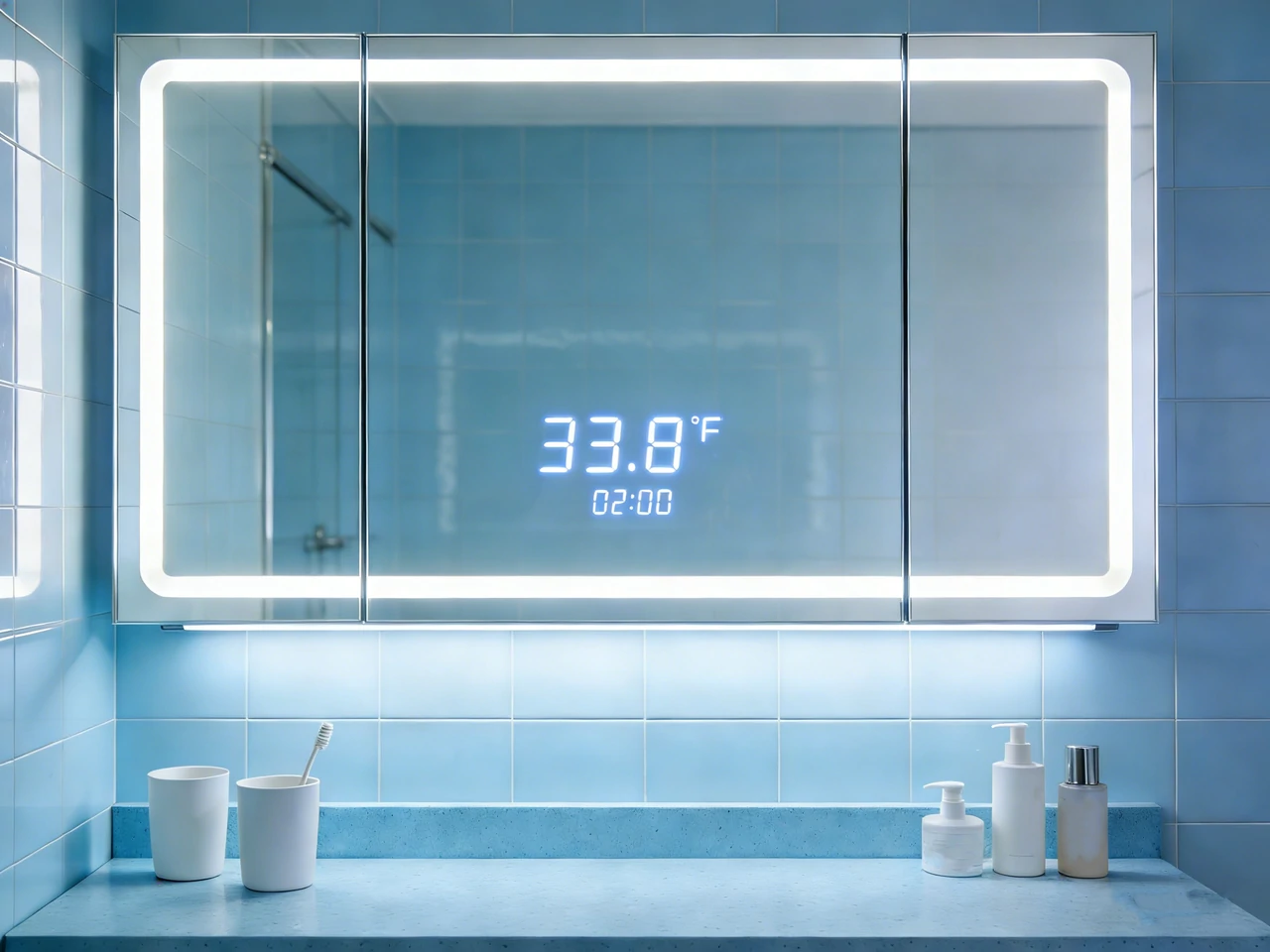
- Optional subsystems: defogger heater pad (fogless LED mirrors), clock/temperature display, occupancy logic boundary
- Mounting hardware: bracket type, anti-rotation, load rating, corrosion resistance
- Packaging engineering: corner protection, carton compression, pallet pattern, drop-test criteria
- Spares: driver modules, sensor assemblies, heater pads, mounting brackets; plus a defined spare ratio per unit count
For smart vanity mirrors bulk orders, clarify early whether “smart” means only local features (dimming/CCT, display) or includes external integration (0–10V, DALI). Avoid ambiguous scope that causes change orders late in the submittal phase.
Performance Outcomes For LED Bathroom Mirrors Wholesale Projects
Project stakeholders evaluate lighted bathroom mirrors supplier proposals on measurable outcomes:
- Visibility: vertical illuminance at face height, uniformity across the mirror plane, color stability
- Glare control: diffuser luminance, shielding, avoidance of pixelation/hot spots, reflected glare from glossy wall tile
- Durability: corrosion resistance of mirror backing, driver thermal margin, ingress protection, condensation behavior
- Compliance: third-party safety listing or conformity marks appropriate to market, and consistent factory quality documentation
References And Documentation Requirements For LED Bathroom Mirrors Wholesale
For procurement files, require documentation that is auditable and shipment-specific:
- Safety certification: UL Listing/Recognition or ETL Listing for North America; CSA certification for Canada where required; CE and applicable EN standards evidence for EU; UKCA evidence for the UK.
- Substance compliance: RoHS declarations supported by test reports where appropriate.
- Quality system: ISO 9001 certificate scope matching the production site and product category.
- Traceability: driver label data, date code, batch/lot numbers, and a defined retention period for production records.
Avoid relying on marketing certificates or generic declarations not tied to a defined bill of materials (BOM).
Specification Parameters For Light Performance Of LED Bathroom Mirrors Wholesale
Lighting performance is the primary functional differentiator between decorative mirrors and project-grade products. Specifications should be written so they can be verified via incoming inspection, photometric sampling, and commissioning.
LED Package And Efficacy Targets For LED Bathroom Mirrors Wholesale
Common LED formats include SMD packages such as 2835 and 5050. For specification, the package name alone is insufficient; define performance at the module/strip level:
- Input power density (W/m): typical project ranges are approximately 9–16 W/m depending on architecture and brightness target.
- Luminous flux density (lm/m): often aligned with the power density; require measured values at stated ambient and stabilized temperature.
- Lifetime metrics: specify lumen maintenance (e.g., L70) and request supporting component data (LED package LM-80/TM-21 where available) plus driver life expectation at rated temperature.
In multi-unit procurement, efficacy should be evaluated with thermal design and diffuser losses included; aggressive lm/W claims that ignore system losses tend to translate into brightness inconsistency across batches.
Color Quality Requirements For LED Bathroom Mirrors Wholesale
For commercial vanity lighting, write requirements that prevent batch-to-batch variation:
- CRI (Ra): specify ≥90 where accurate skin tone and finish evaluation are required (hospitality vanity zones, high-end retail fitting rooms). CRI ≥80 may be acceptable in back-of-house or general washroom lighting where mirrors are not the primary grooming light.
- CCT: typical ranges are 3000K–4000K for hospitality and 3500K–5000K for clinical/healthcare depending on design intent. Define nominal CCT and allowable tolerance.
- Color consistency (SDCM/MacAdam): specify ≤3 SDCM for premium uniformity; ≤5 SDCM can be acceptable for budget-sensitive, high-volume applications if mixed-batch installation is controlled.
For large developments, require binning controls and documented LED procurement strategy (same bin per PO, or controlled equivalency rules).
Optical Design Considerations For LED Bathroom Mirrors Wholesale
Optical design should be specified by outcomes, not only by materials:
- Diffusion quality: require “no visible LED points at 1.0 m viewing distance” (or a defined distance) for front-lit mirrors; for backlit, require hot-spot control on the wall perimeter.
- Shadowing: front-lit architectures reduce facial shadowing; backlit can create edge emphasis with weaker frontal fill. If the mirror is the primary vanity luminaire, front-lit or hybrid designs are typically easier to validate.
- Glare limits: specify maximum surface luminance for the light window/diffuser where feasible, or require a glare assessment approach aligned with the project lighting design.
- Uniformity: define allowable brightness variation across the emitting zone, especially for large-format rectangles and custom shapes.
Visual Elements Of LED Bathroom Mirrors Wholesale Performance
| Parameter |
Typical project baseline |
Common premium target |
Notes for procurement control |
| System input power |
20–60 W (size-dependent) |
size-dependent |
Define measured watt at rated voltage, stabilized temp |
| Luminous flux (system) |
1200–3000 lm |
2000–4000 lm |
Require test method and sampling plan |
| LED strip/module power density |
9–16 W/m |
12–18 W/m |
Higher density increases thermal sensitivity |
| CRI (Ra) |
≥80 |
≥90 |
Specify test report format and acceptance |
| CCT |
3000K / 4000K / 5000K |
tuned to lighting design |
Define tolerance (e.g., ±150K) |
| Color consistency |
≤5 SDCM |
≤3 SDCM |
Critical for multi-batch projects |
| Flicker |
defined limit |
tighter limit |
Require measurement approach (percent flicker / flicker index) |
Mirror Substrates Coatings And Corrosion Resistance For LED Bathroom Mirrors Wholesale
Mirror durability failures in humid bathrooms often present as edge corrosion, backing degradation, or local “black spots.” These are avoidable with controlled materials and edge sealing policies.
Glass Build Thickness And Finishing For LED Bathroom Mirrors Wholesale
Typical mirror glass thickness is 4–6 mm for wall-mounted LED mirrors; large formats or public-space robustness may justify thicker glass or reinforced backing design. Specify:
- Thickness tolerance consistent with the mounting system and edge reveal
- Edge finishing (arrised, pencil polish, flat polish) and allowable chip limits
- Tempering/heat treatment requirements if safety glass behavior is mandated by local code or project risk policy (note: tempering affects edge work requirements and distortion limits)
Dimensional tolerances should be tied to the optical window alignment so that light channels remain uniform across production.
Copper-Free Vs Silver-Backed Mirrors For LED Bathroom Mirrors Wholesale
In wet, poorly ventilated, or high-usage environments, copper-free mirror backings are often specified to improve corrosion resistance at edges and cutouts. Traditional silver-backed mirrors can perform well when edge protection and backing integrity are controlled, but are more sensitive to persistent moisture ingress.
For fogless LED mirrors, the heater pad reduces condensation on the viewing area but does not eliminate humidity exposure at edges; corrosion prevention still depends on backing chemistry, edge sealing, and correct spacing from wet-zone spray.
Safety And Durability Considerations For LED Bathroom Mirrors Wholesale
Commercial specifications should address:
- Safety behavior: whether the mirror must remain adhered on impact (safety film/backing strategy) depending on application risk.
- Backing board: moisture-resistant backing material, stable bonding, and adhesive compatibility with heater pads and LED thermal tapes.
- Edge protection: sealed edges, gasket interfaces, or framed perimeters where wet cleaning and repeated condensation are expected.
Testing References For LED Bathroom Mirrors Wholesale
Where projects require formal verification, reference applicable glass and mirror test methods (impact/safety characteristics, environmental exposure) aligned to jurisdiction. For international projects, write the requirement as “test to applicable ASTM/EN method as accepted by the authority having jurisdiction,” and require third-party lab reports for the delivered configuration.
Electrical Architecture Safety And Compliance Standards For LED Bathroom Mirrors Wholesale
Lighted mirrors combine mains power, low-voltage LED circuits, and (often) resistive heater pads. Electrical design decisions should prioritize safety margins, serviceability, and predictable dimming behavior.
Driver Selection And Electrical Performance For LED Bathroom Mirrors Wholesale
- Constant-voltage drivers are common with LED strips; the strip design must manage current and thermal behavior. This can simplify field replacement when the LED assembly is modular.
- Constant-current drivers can improve current stability and uniformity but require a matched LED load; substitutions are less flexible.
For commercial projects, specify:
- Input voltage/frequency (e.g., 120V 60Hz, 220–240V 50/60Hz) and surge protection expectation
- Flicker performance with defined measurement metrics
- Power factor (PF) and total harmonic distortion (THD) targets when large quantities are installed (hotel towers, resorts) to reduce upstream electrical penalties and nuisance issues
Ingress Protection And Wet-Zone Suitability For LED Bathroom Mirrors Wholesale
Define ingress protection based on bathroom zoning and cleaning regime, not as a generic checkbox. Typical project baselines:
- IP44 for splash-resistance in many vanity locations
- Higher IP ratings where mirrors may be exposed to direct spray or aggressive washdown (jurisdiction-dependent)
Coordinate with the project’s wet-zone classification and the mirror’s mounting position relative to basins, showers, and partitions. Require the IP rating to apply to the as-installed assembly, including sensor windows and cable entries. Refer to
IEC IP ratings for standardized ingress protection definitions.
Certification Pathways For LED Bathroom Mirrors Wholesale By Market
Write compliance requirements as market-specific deliverables:
- US: UL Listing or ETL Listing to applicable luminaire/electrical standards; require the exact file number and model mapping.
- Canada: CSA certification or accepted equivalent as required by local authorities.
- EU: CE marking supported by technical documentation and applicable EN standards; request the Declaration of Conformity.
- UK: UKCA marking with supporting documentation as required.
Avoid specifying “CE only” for markets that require third-party safety listing.
Frequently Asked Certifications For LED Bathroom Mirrors Wholesale
Typical requirements are driven by jurisdiction and the project’s risk and insurance policies, but often include:
- a recognized electrical safety listing/mark for the destination country
- RoHS compliance where applicable
- documentation of ingress protection (IP) appropriate to the bathroom zone
- factory quality system evidence (ISO 9001) and shipment traceability
Controls Smart Features And System Integration For LED Bathroom Mirrors Wholesale
Controls affect not only user experience but maintenance burden, commissioning, and replacement strategy across hundreds of rooms.
Control Options For LED Bathroom Mirrors Wholesale
Common options include:
- Local touch: clean appearance, but must be validated for wet-finger operation and cleaning chemical exposure.
- IR/wave sensor: reduces touch wear; must be validated for false triggering in tight vanities.
- Wall-switch control: preferred in many hospitality standards for consistency with room switching and lower mirror electronics complexity.
- Dimming interfaces: 0–10V and DALI are common in commercial lighting controls; TRIAC compatibility is project-specific and driver-dependent.
For specification, define the control boundary: whether the mirror remembers last state after power loss, how it behaves on wall-switch cycling, and whether drivers are dimmable without flicker or audible noise.
Defogging And Anti-Fog Heater Pads For LED Bathroom Mirrors Wholesale
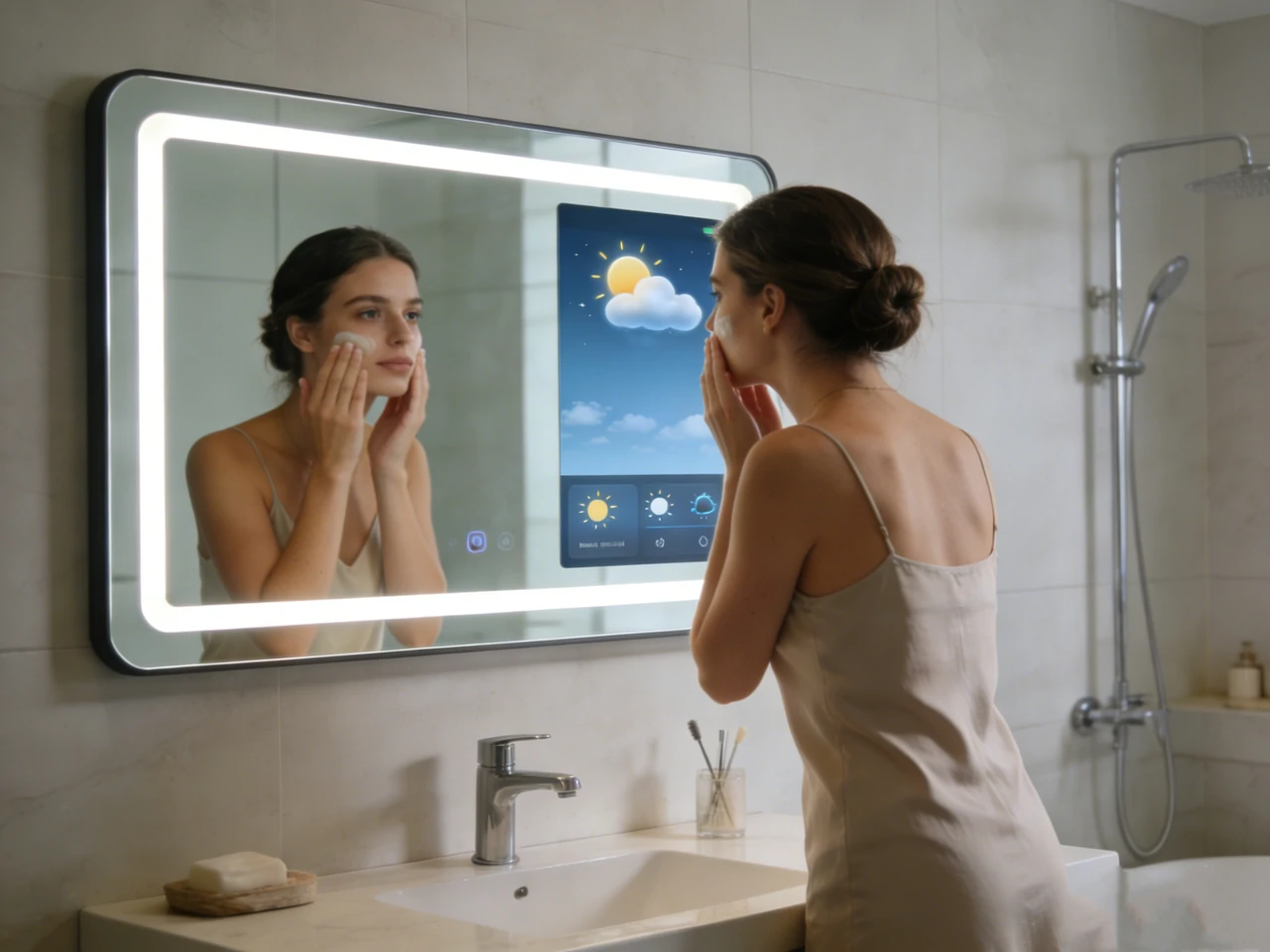
Fogless LED mirrors typically use resistive heater pads bonded to the rear of the mirror. Key specification points:
- Watt density (W/in² or W/cm²) and total heater wattage
- Coverage area (percentage of mirror viewing zone) to match expected condensation pattern
- Control logic: interlock with lighting, independent switch, or timed shutoff; timed control is often used to manage energy and reduce overheating risk
- Thermal safety: require over-temperature protection strategy where applicable
Smart Integration Boundaries For LED Bathroom Mirrors Wholesale
For smart vanity mirrors bulk programs, define whether features are permitted based on the operator’s maintenance model. In hotel and healthcare environments, additional electronics can increase failure points and introduce compliance considerations. If smart features are included, specify:
- modular replacement approach (sensor/display module replaceable without de-bonding the mirror)
- spare parts strategy and service documentation
- clear separation of mains and extra-low voltage sections for safety inspections
Visual Element: System Block Diagram
Text diagram for specification documents:
Mains supply → (Junction box / connection point) → Driver (AC/DC) → LED modules (front-lit/backlit) → Control interface (touch/sensor/wall control) → Optional defogger (heater pad with timer/thermostat) → Protective earth / grounding continuity
Mechanical Design Mounting And Site Coordination For LED Bathroom Mirrors Wholesale
Commercial mirror failures often result from mismatched rough-in positions, inconsistent bracket geometry, or inadequate service access—not from the glass itself.
Mounting Interfaces And Bracket Systems For LED Bathroom Mirrors Wholesale
Specify mounting as an engineered interface:
- Bracket type (keyhole, Z-bar, rail) and corrosion resistance
- Load rating with safety factor
- Anti-rotation features to prevent field misalignment
- Standoff distance (critical for backlit optical performance and cable routing)
Large-format mirrors and public-area installations should include rear frames or stiffeners to control flatness and reduce torsion during mounting.
Electrical Rough-In Coordination For LED Bathroom Mirrors Wholesale
At planning stage, define:
- required junction box location zones (horizontal/vertical tolerances)
- cable exit direction and minimum bend radius
- whether the driver is behind the mirror or remotely located (remote drivers can simplify service but require coordination space and thermal management)
Do LED mirrors require a dedicated electrical box? In most commercial specifications, a defined junction box/connection point is required to meet electrical code practice and to support repeatable rough-in across rooms. Whether it is “dedicated” depends on local code and the electrical design, but the mirror should not rely on ad-hoc splices hidden behind the glass. Write the requirement as a coordinated rough-in location with accessible service strategy.
Dimensional Control For LED Bathroom Mirrors Wholesale
Dimensional control affects both appearance and rework risk:
- overall width/height tolerance
- squareness
- position tolerance of the light window relative to mirror edges
- allowable edges reveal variance when multiple mirrors are installed in a corridor or stacked configuration
Include tolerances in the approved drawing package and require first-article confirmation before mass production.
Junction Box Location And Service Access Guidelines For LED Bathroom Mirrors Wholesale
Specify a rough-in zone rather than a single point: define a rectangular allowable area behind the mirror where the junction box must land, plus a required clearance volume for connectors and driver access. Also define service access method (mirror removable without tile demolition, or driver accessible via rear hatch if framed). This reduces site variation risk across multi-floor installations.
Manufacturing Quality Controls And Reliability Validation For LED Bathroom Mirrors Wholesale
Wholesale sourcing success depends on reducing variability, not only achieving a compliant sample. Quality controls should be written into the supply agreement and verified with defined acceptance criteria.
Incoming QC Checks For LED Bathroom Mirrors Wholesale
Incoming inspection should include:
- glass surface defect limits (scratch/dig criteria appropriate to viewing distance)
- backing/coating inspection for pinholes and edge coverage
- verification of LED binning documentation (CCT/SDCM bins)
- driver traceability: label data matched to incoming records and safety certification scope
In-Process And Final QC For LED Bathroom Mirrors Wholesale
For project mirrors, typical controls include:
- burn-in to screen early driver/LED failures
- functional test of all controls, sensors, and heater pad operation
- photometric sampling (flux and CCT/SDCM checks on a sampling plan)
- cosmetic inspection under defined lighting conditions and angles
Reliability Validation For LED Bathroom Mirrors Wholesale
Reliability validation should reflect bathroom conditions:
- humidity exposure and thermal cycling to reveal backing corrosion pathways and adhesive creep
- adhesion tests for heater pads and diffusers
- defogger endurance cycling (on/off cycles, timed control verification)
- driver thermal verification at worst-case ambient within the mirror cavity
Visual QC Elements And Acceptance Criteria For LED Bathroom Mirrors Wholesale
| Checkpoint |
Method |
Typical defect class |
Example acceptance approach |
| Glass cosmetics |
Visual under defined lux |
Critical/Major/Minor |
AQL plan with critical = 0 acceptance |
| Dimensions & squareness |
Jig + calibrated tools |
Major |
100% check on first article; sampling thereafter |
| Electrical safety |
Continuity, insulation, leakage (as applicable) |
Critical |
100% test |
| Lighting function |
On/off, dimming, CCT change |
Major |
100% functional test |
| Color consistency |
CCT/SDCM measurement |
Major |
Sampling per batch; bin control verification |
| Defogger function |
Heat-up test + timer logic |
Major |
Sampling + periodic endurance validation |
| Packaging integrity |
Drop/carton compression verification |
Major |
Periodic validation + incoming packaging QC |
LED Bathroom Mirrors Wholesale Commercial Sourcing And Logistics
For LED bathroom mirrors wholesale programs, procurement should be structured to reduce redesign loops and late-stage compliance gaps.
MOQ Strategy And Production Scaling For LED Bathroom Mirrors Wholesale
A typical staged approach is:
- Engineering sample: validate drawings, light output, control logic, and finish alignment with vanity and wall systems.
- Pilot run: verify manufacturing repeatability, packaging survival, and compliance documentation mapping to the final BOM.
- Production scaling: lock bins for LEDs, lock driver model, lock mounting hardware revision, and manage controlled substitutions only via written deviation.
This structure is particularly important for smart vanity mirrors bulk orders where electronics variation can create field failures that are difficult to diagnose after installation.
Lead Time Structure For LED Bathroom Mirrors Wholesale
Lead time should be decomposed into controllable gates:
- drawing approval and any tooling (custom frames, custom diffusers)
- first-article build and approval
- mass production
- QA hold for inspection documentation and labeling verification
- export packaging and shipment booking
For custom sizes or non-standard shapes, add time for photometric confirmation and packaging drop testing of the final packed configuration.
Packaging Engineering For LED Bathroom Mirrors Wholesale
Mirrors are damage-sensitive and return logistics are costly in commercial channels. Packaging requirements should define:
- corner protection design and minimum clearance to glass edge
- carton strength and compression target for stacked pallets
- pallet pattern, maximum stack height, and banding method
- labeling: model code, room/area code if kitting, orientation marks, and handling instructions
Packaging must be validated for the shipment mode (parcel, LTL, containerized) and the expected number of touches.
Realistic Lead Times For Container-Scale LED Bathroom Mirrors Wholesale Orders
For container-scale orders with custom dimensions, realistic planning typically includes time for drawing approval, first-article validation, and batch production. Lead times often extend when custom packaging, new control configurations, or market-specific certification labeling must be integrated. Buyers should require a supplier to provide a gated schedule with defined approval points rather than a single date estimate.
Selection Framework By Application For LED Bathroom Mirrors Wholesale
Application-driven specification reduces lifecycle cost by preventing over- or under-specification.
Hospitality: Guestroom Standardization, Dimming Expectations, Anti-Fog Duty Cycle
Hospitality programs prioritize:
- consistent appearance and color across floors and refurbishment phases (SDCM control)
- predictable behavior with wall-switch power cycling
- defogger duty cycle aligned with guest usage and ventilation reality; specify heater wattage and timed shutoff logic
- glare control appropriate for mirror use at close distances
Average lifespan of LED mirrors in hotel rooms: project-grade designs commonly target long service life through thermal margin and driver quality. In practice, lifetime depends on driver temperature, LED current density, and humidity control. Write the requirement as lumen maintenance (e.g., L70) and driver life at a stated ambient temperature, and require burn-in plus traceability to reduce early failures.
Are LED mirrors energy-efficient for large resorts? Yes, when specified by system wattage and control logic. Energy performance is strongest when mirrors use efficient LED systems, limit defogger runtime with timers, and avoid high standby loads from always-on displays. For resorts with hundreds of rooms, specify PF/THD targets to maintain electrical quality at scale.
Healthcare: Cleanability, Electrical Safety Documentation, Glare Control, Robustness
Healthcare environments typically require:
- cleanable surfaces and sealed interfaces to reduce moisture ingress during frequent cleaning
- conservative electrical documentation and verifiable safety listings
- robust mounting to prevent misalignment and damage
- glare control to support patient comfort and staff tasks
If antimicrobial claims are requested, treat them as a separate compliance and validation topic with documented test methods; do not assume a coating is acceptable without project approval.
Multi-Unit Residential Projects: Repeatable Rough-In, Spare Parts Policy, Consistency Across Batches
Multi-unit developments require:
- tight coordination of junction box rough-in zones across repetitive units
- consistent dimensions for vanity/mirror alignment
- defined spares policy (drivers, sensors, heater pads) and a long enough parts availability window to support defects and turnover maintenance
- controlled substitutions across production lots to avoid visual mismatch between phases
Specifications That Reduce Failure Rates For LED Bathroom Mirrors Wholesale In High-Humidity Environments
Failure rates are most influenced by:
- corrosion-resistant mirror backing selection (often copper-free) plus edge protection policy
- ingress protection appropriate to zone and cleaning regime
- driver thermal design margin and burn-in screening
- controlled adhesive systems for heater pads and diffusers validated under humidity/thermal cycling
- documented binning controls for LED color consistency to prevent room-to-room mismatch during partial replacements
FAQs
What is the difference between front-lit and backlit mirrors in commercial specifications?
Front-lit LED bathroom mirrors wholesale designs emit light directly toward the user through a diffuser, light window, or etched pattern, making them easier to specify for facial illuminance and uniform lighting. Backlit hotel mirrors, on the other hand, place the LED source behind the mirror plane to create a soft wall “halo,” reducing perceived glare while providing ambient illumination. Their performance depends heavily on wall reflectance, standoff distance, and diffuser geometry to achieve the desired brightness at face height. When sourcing smart vanity mirrors in bulk or from a lighted bathroom mirrors supplier, it is important to clarify whether the project requires front-lit, backlit, or hybrid designs to ensure consistent lighting across multiple units.
What CRI rating is recommended for professional vanity lighting in hospitality or retail?
For LED bathroom mirrors wholesale used in hospitality or retail, a CRI (Ra) of ≥90 is recommended where accurate color rendering is essential for grooming, makeup, or appearance evaluation. CRI ≥80 may be acceptable for back-of-house washrooms or areas where the mirror is not the primary light source. When ordering backlit hotel mirrors, fogless LED mirrors, or smart vanity mirrors in bulk, specifying CRI ensures consistent skin tone accuracy and minimizes batch-to-batch color variations across multiple rooms or units.
Can LED light sources be replaced if they fail in multi-unit installations?
Replacement depends on whether the LED bathroom mirrors wholesale product is designed with modular, serviceable LED boards or strips and accessible drivers. Smart vanity mirrors bulk orders and commercial projects often require mirrors that allow for easy module replacement to minimize downtime. Fully sealed or integrated constructions, including some backlit hotel mirrors and fogless LED mirrors, may require full mirror replacement if LEDs fail. When purchasing from a lighted bathroom mirrors supplier, confirm serviceability and spare parts availability to avoid costly replacements.
Do lighted bathroom mirrors require hardwiring to a junction box?
Most commercial projects sourcing LED bathroom mirrors wholesale require a defined junction box or connection point to meet electrical code practice, ensure repeatable rough-in, and facilitate maintenance. Backlit hotel mirrors, fogless LED mirrors, and smart vanity mirrors bulk installations all need accessible wiring and service strategies. The exact requirements depend on local jurisdiction and the mirror’s listing, but specifying a coordinated rough-in zone and accessible driver or control modules ensures consistent installation and future servicing.
What documentation should be requested from a lighted bathroom mirror supplier for project submittals?
When sourcing LED bathroom mirrors wholesale or smart vanity mirrors in bulk, request full project documentation from the lighted bathroom mirror supplier. This should include safety certification evidence (UL/ETL for the US,
CE for the EU,
CSA for Canada, UKCA for the UK), IP rating details, RoHS compliance declarations, ISO 9001 certification of the production site, photometric and color test reports for the configured BOM, and batch traceability for drivers and LED bins. For backlit hotel mirrors or fogless LED mirrors, proper documentation ensures compliance, consistent quality, and reliable performance across all units installed in hospitality, healthcare, or multi-unit residential projects.
References