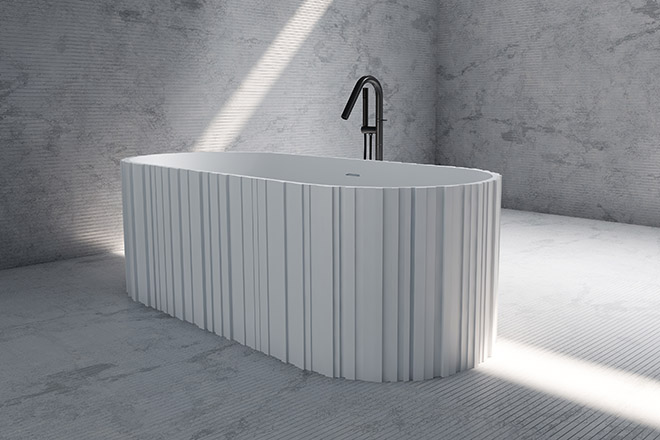
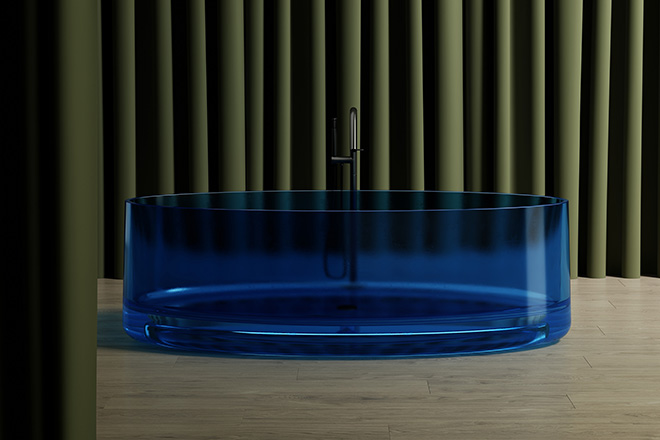
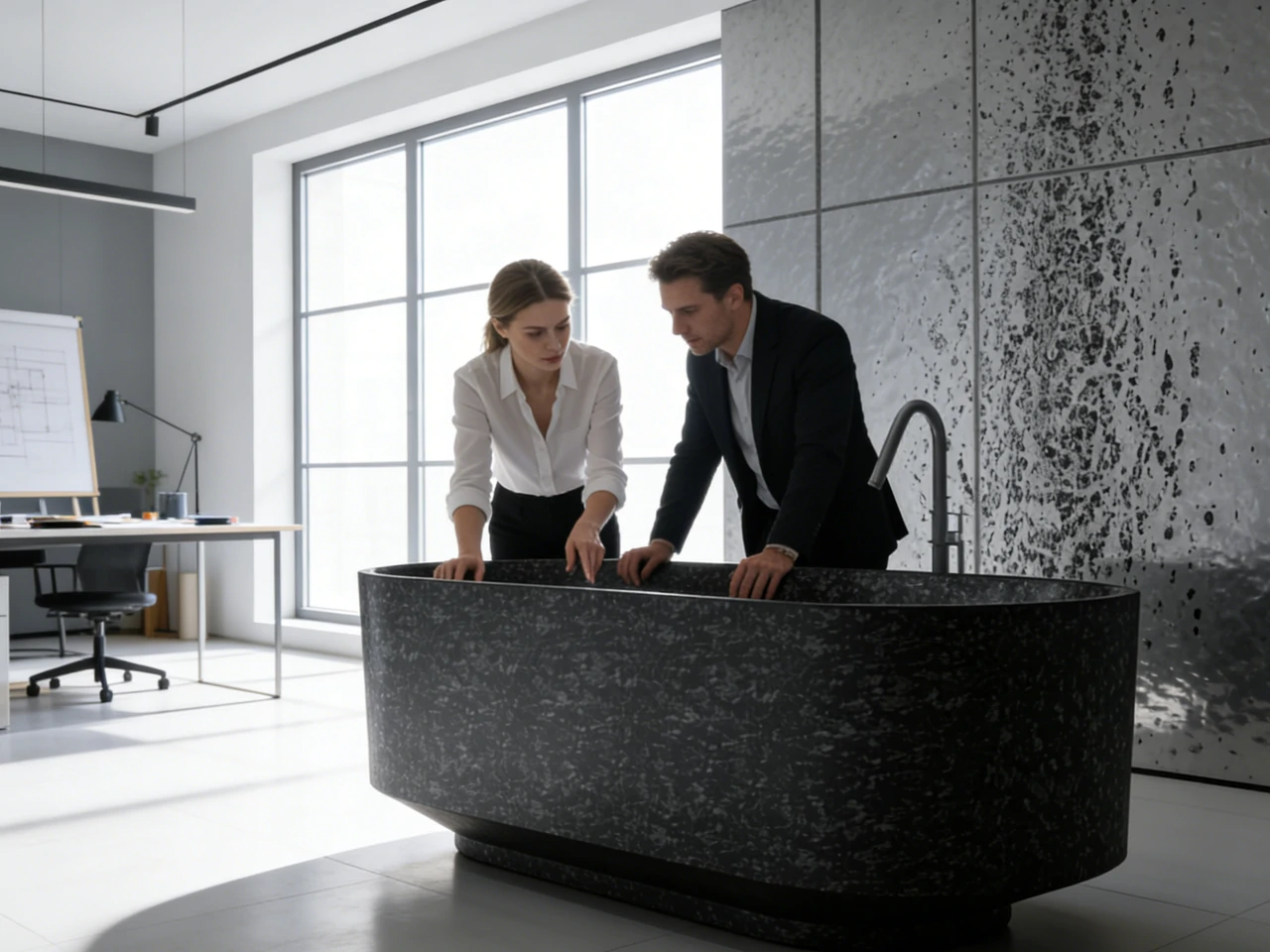
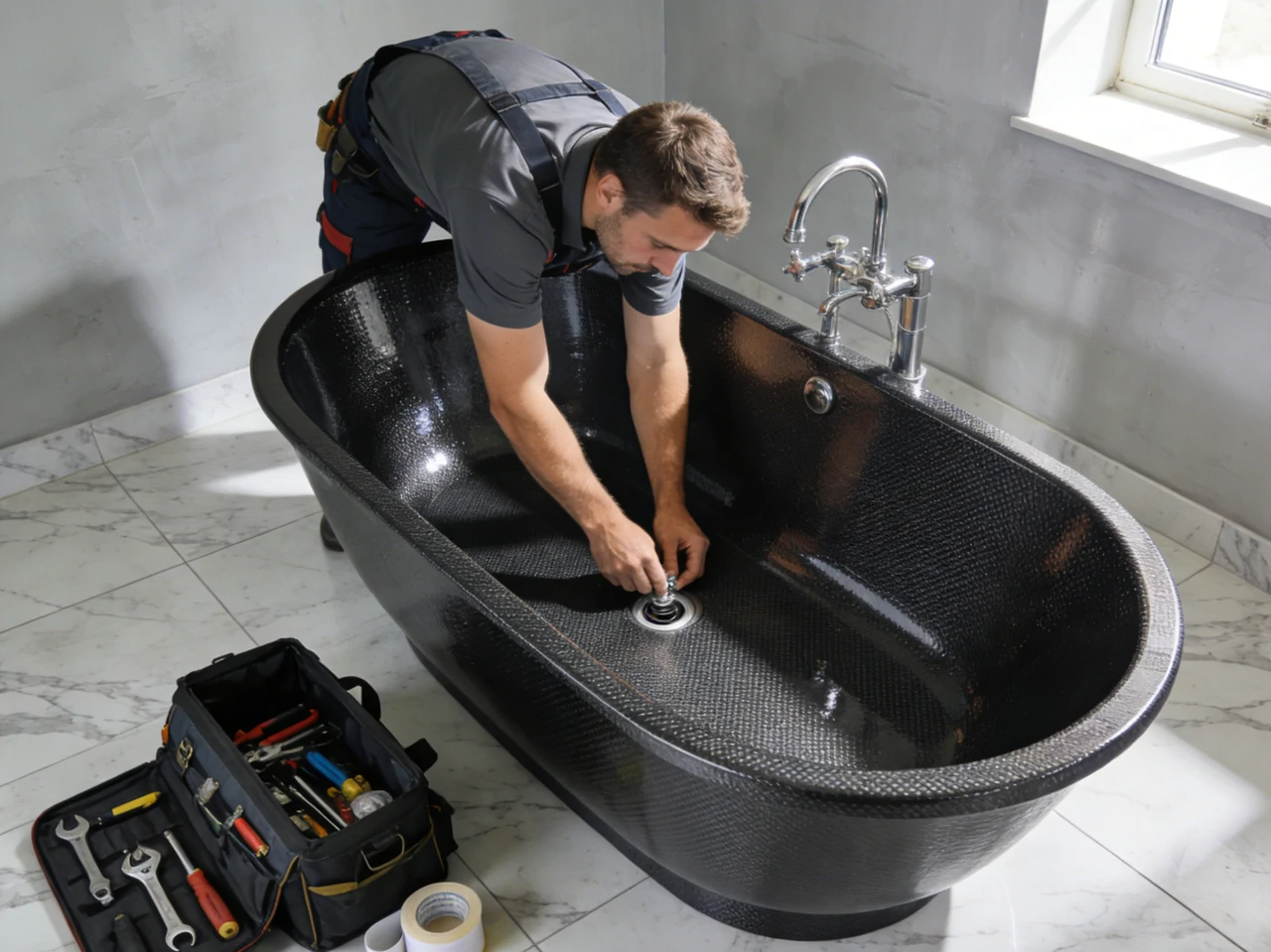
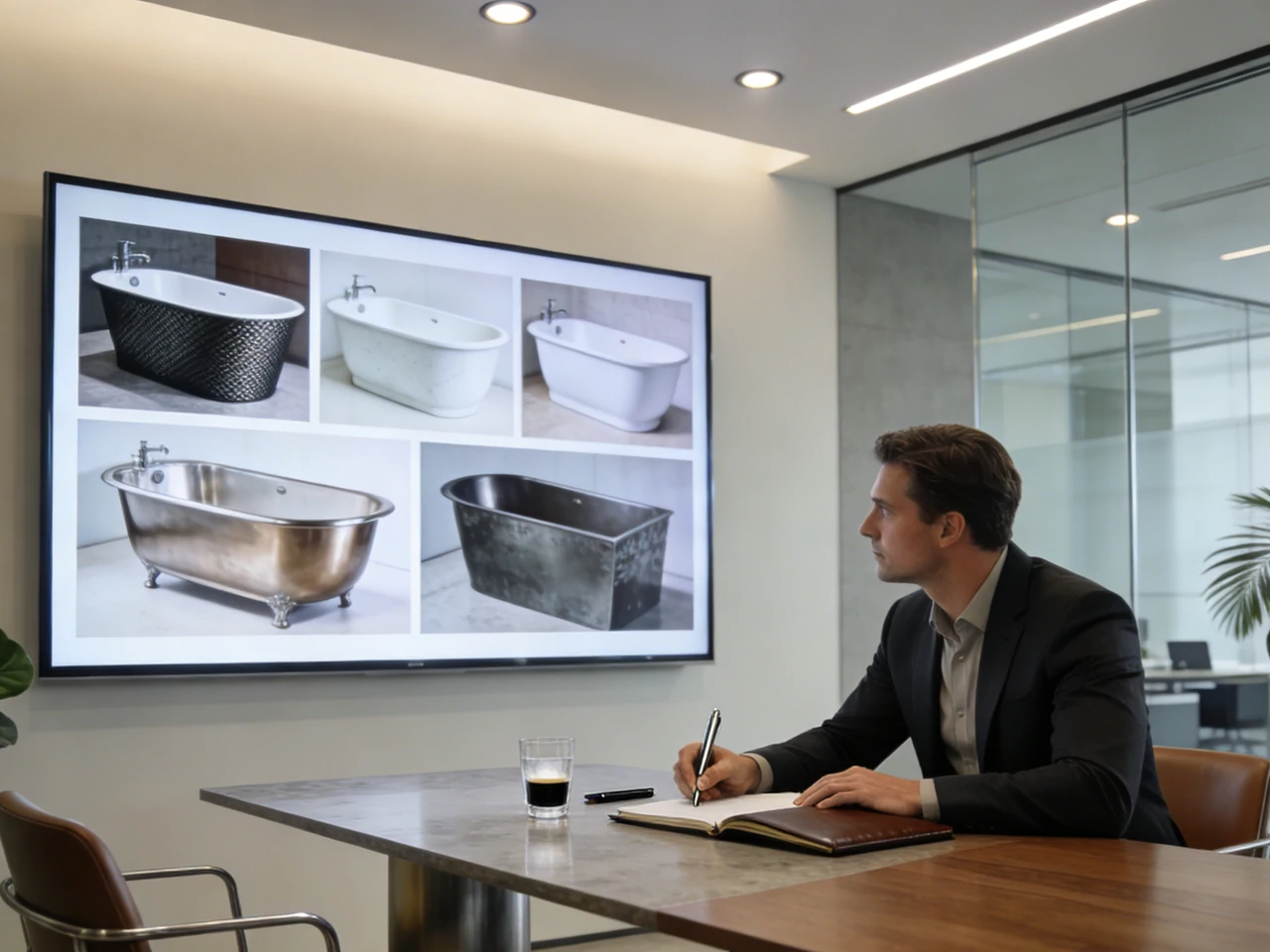
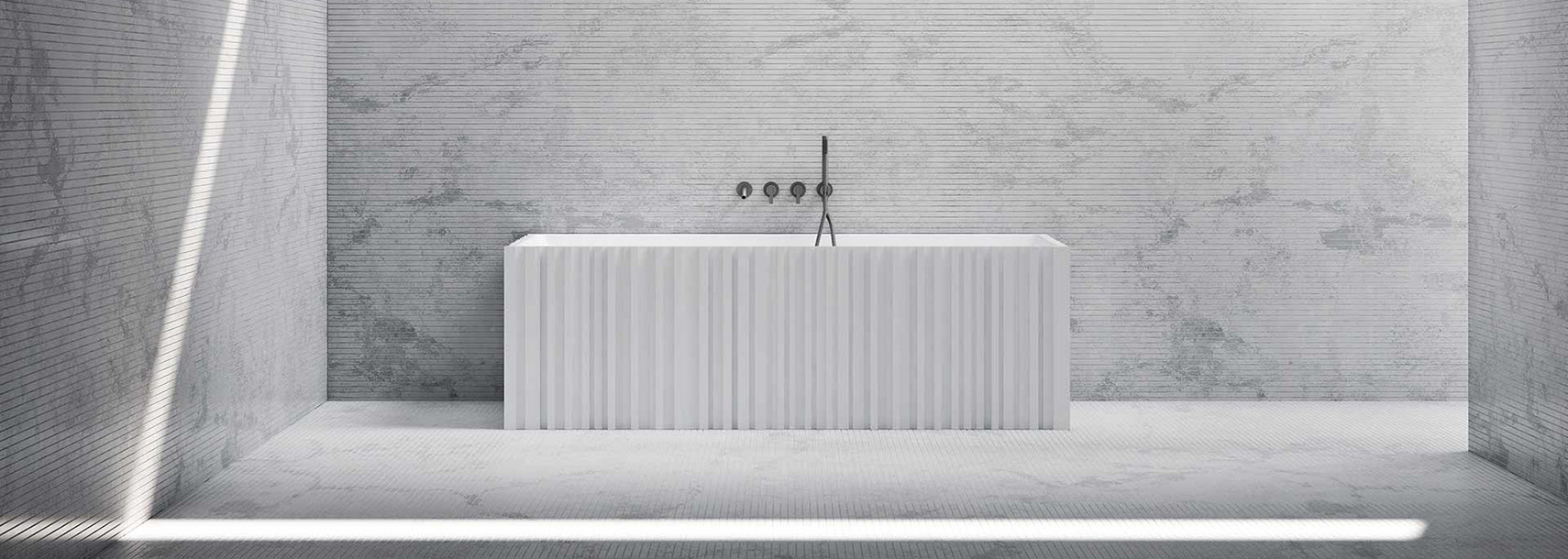
Carbon fiber bathtubs occupy a specialized segment of high-end bathroom fixtures, where the driver is not only visual differentiation, but measurable project constraints: mass reduction for site logistics, geometric freedom for signature interior design concepts, and controlled quality in low-volume programs. As a carbon fiber bathtub manufacturer evaluates project fit, a luxury carbon fiber tub must be understood as both a design object and an engineered bathroom fixture, balancing elegance, strength, and durability.
From a manufacturer perspective, a carbon fiber tub must be specified as part of a complete bathroom system—waste-and-overflow, valves, waterproofing build-ups, adjacent finishes, and service access—because composite material construction shifts tolerances, interfaces, and repair pathways compared with acrylic, cast iron, or stone bathtubs.
Carbon fiber bathtub vs. CFRP composite bathtub: terminology and inclusions/exclusions
For procurement and compliance language, “carbon fiber bathtub” is commonly used as a visual and product descriptor within the luxury bathroom market. Technically, most products are CFRP (carbon fiber reinforced polymer), meaning carbon fiber reinforcement in a polymer matrix. The term “CFRP composite bathtub” is more precise and helps distinguish structural performance from cosmetic style choices.
Clarify in the specification:
- Whether the tub is structural CFRP throughout or a hybrid composite (carbon face ply over glass reinforcement, or CFRP shell on a support frame).
- Whether “forged carbon” refers to chopped-fiber aesthetic (visual pattern) versus a stiffness-driven layup.
- Whether the visible carbon is the finished surface or a decorative layer under a clear coating (critical for UV/chemical resistance and repairability).
- Inclusions/exclusions: waste-and-overflow kit, drain cover style, access panel requirements, insulation/backing, integrated lighting or hydro features (if applicable), and whether valves/fittings are supplied or coordinated by others.
Typical commercial use cases: hospitality, branded residences, marine/yacht, and flagship retail
Carbon fiber bathtubs are specified where conventional bathtub materials introduce limitations:
- Hospitality suites and branded residences: statement freestanding bathtub design with controlled repeatability across a limited run; emphasis on finish consistency and maintenance protocols for housekeeping teams.
- Marine/yacht applications: lightweight soaking tubs that reduce handling complexity and support broader weight management strategies; additional attention to vibration, anchoring, and corrosion-resistant interface components.
- Flagship retail and showcase environments: emphasis on tight cosmetic standards under high lighting, and on documented repair methods to manage damage risk in public-facing spaces.
Decision criteria at concept stage: weight, geometry freedom, finish level, and program risk
At concept stage, selection of a high-end carbon fiber bathtub should be based on criteria that translate directly into engineering and supply-chain commitments:
- Lightweight performance: CFRP enables a dramatic reduction in mass compared with stone or cast iron baths, changing logistics and installation strategy—but still requiring engineered support for freestanding stability.
- Geometry freedom: deep soak profiles, thin edges, and sculptural shapes are achievable, but must respect laminate drape limits and coating build to avoid distortion.
- Finish and surface beauty: high-gloss or “deep” visual effects are coating-driven; surface systems must be specified with clear expectations for abrasion, chemical exposure, and long-term elegance.
- Program risk: low-volume composite manufacturing is process-sensitive. Without defined tolerances and inspection protocols, variation appears across units in symmetry, gloss, and drain alignment.
Specification table: minimum data set required before RFQ (dimensions, drain location, finish, compliance)
A carbon fiber bathtub manufacturer can only price, tool, and commit to tolerances when the RFQ includes a minimum dataset.
| Category |
Minimum RFQ data |
Notes for project coordination |
| Overall size |
Length × width × height; rim profile; base footprint |
Identify reference datums (centerline, rim plane, drain center) |
| Type |
Freestanding / built-in / skirted |
Defines waterproofing and finish interfaces |
| Drain |
Drain outlet diameter; drain center location (X/Y); vertical stack height allowance |
Confirm waste-and-overflow routing and service access strategy |
| Overflow |
Presence/absence; overflow type; target fill level |
Clarify “overflow intent” early to avoid late redesign |
| Capacity |
Target water volume at overflow; bather capacity assumptions |
Needed for thermal and structural considerations |
| Surface |
Visible carbon / pigmented finish; gloss level; color targets |
Define coating system and acceptance criteria (gloss, haze, DOI) |
| Slip/surface safety |
Surface friction approach and test method |
Specify test standard and wet-condition acceptance basis |
| Compliance |
Plumbing code basis; any required listing/third-party evaluation |
Jurisdiction-dependent; confirm early with AHJ |
| Packaging/logistics |
Crate limits; lift points; site handling constraints |
Lightweight does not equal damage-proof; specify protection |
| Documentation |
Drawings, material declarations, QA records, test reports |
Tie to submittal milestones and approvals |
Materials, laminate architecture, and performance characteristics
Carbon fiber performance in a bathtub application is governed less by headline fiber strength and more by laminate design, resin system choice, cure quality, and surface system durability in a wet, chemically variable environment. For project teams, the goal is to specify what is measurable: fiber architecture, resin family, void/defect controls, and coating performance.
Reinforcement options: woven carbon, UD layups, and forged carbon aesthetics vs. stiffness
- Woven carbon fiber fabrics: good drape for complex bathtub shapes; balanced mechanical properties; commonly selected where visible carbon craftsmanship is part of the design intent.
- Unidirectional (UD) layers: used strategically in rims, bases, or load paths to control deflection and improve structural strength.
- Forged carbon aesthetics: visually distinctive, but typically paired with structural laminates to meet performance requirements.
From a manufacturer standpoint, always clarify whether the visible carbon layer is structural or cosmetic to avoid unintended performance trade-offs driven by style decisions.
Resin systems and service limits: epoxy vs. vinyl ester; UV/chemical exposure assumptions
Resin choice influences heat distortion margin, water uptake, chemical resistance, and coating compatibility:
- Epoxy systems: commonly used with prepregs and autoclave curing; strong mechanical properties and good adhesion; often needs a defined UV-protective surface system if carbon is visible.
- Vinyl ester systems: often used in infusion/RTM workflows; generally favorable chemical resistance; processable for larger parts with different tooling economics.
For specification, define:
- Service temperature assumptions (hot water exposure range and duration).
- Chemical exposure assumptions (typical cleaning chemistry, disinfectants, and descaling frequency for hospitality).
- UV/light exposure (daylight in bathrooms, storefront lighting), because visible carbon and clear coats can be sensitive to UV-driven yellowing without appropriate stabilization.
Strength-to-weight implications for handling and site logistics (lightweight freestanding tub requirements)
Lightweight freestanding bathtubs reduce transport and handling loads, but introduce other requirements:
- Stability engineering: a low-mass freestanding bathtub must resist rocking under occupant movement; base geometry, contact pads, and under-structure stiffness become primary.
- Local reinforcement: lightweight shells require engineered reinforcement at high-stress zones: drain flange region, overflow penetration (if present), rim edges, and any lifting/handling points used in manufacturing or site logistics.
- Damage tolerance: CFRP is strong, but point impacts can cause localized damage not immediately visible under certain coatings. Packaging and handling requirements should be part of the submittal set.
Addressing the common sourcing question “How heavy is a carbon fiber bathtub?”: the range varies widely by size, laminate schedule, and whether a support frame is integrated. The practical procurement approach is to request net tub mass and installed mass (including frame, waste-and-overflow components supplied with the tub, and any insulation/backing) so logistics and on-site sequencing can be planned accurately.
Thermal behavior and surface performance: coefficient of thermal expansion, heat retention, and coating systems
Carbon fiber composites can exhibit relatively low thermal expansion along fiber directions, but the bathtub is a multi-directional laminate with resin-rich regions and coatings; thermal performance is therefore system-level:
- CTE and dimensional stability: specify acceptable movement at the drain interface and around bonded inserts or threaded features. Avoid mixing metals and composites at interfaces without defined isolation and tolerance strategy.
- Heat retention: composite tubs can feel different from metal or stone; thermal behavior is influenced by wall thickness, backing, and any insulation choices. For hospitality specifications, define minimum wall build or insulation requirements if surface temperature stability is critical.
- Coating systems: in most visible-carbon products, the “finish” is a coating stack. Define coating type, minimum dry film thickness (where applicable), abrasion expectations, and chemical resistance test method. This is the main control point for long-term appearance in a commercial bathroom.
Addressing “How do you maintain a carbon fiber tub?” from a facility perspective: specify neutral-pH, non-abrasive cleaning agents, avoidance of aggressive solvents, and defined procedures for stain/scale removal that do not scratch or soften the coating. Maintenance should be documented as an O&M requirement tied to warranty conditions and housekeeping training.
Dimensional specification, ergonomics, and engineering constraints
A carbon fiber bathtub manufacturer should be evaluated on the ability to hold datums and tolerances consistently, because composite parts can distort due to cure shrinkage, thermal gradients, and post-processing. In projects, dimensional ambiguity typically becomes a coordination issue with the waste-and-overflow set-out and adjacent finish lines.
Dimensional control: allowable tolerances, symmetry/warpage criteria, and datum strategy
For freestanding bathtubs, define:
- Primary datums: rim plane, longitudinal centerline, drain center, and base contact plane.
- Tolerances: overall length/width/height, rim flatness, drain center location, and symmetry across the centerline.
- Warpage criteria: maximum allowable twist or “rocking” when placed on a flat reference surface; define measurement method and acceptance.
A practical approach is to require a datum drawing showing measurement points and how the manufacturer verifies them at final inspection.
Capacity, freeboard, and overflow intent: translating design intent into measurable specs
“Deep” and “soak” requirements must be converted into measurable parameters:
- Water depth to overflow (or intended fill line) at a defined tub level condition.
- Freeboard from rim to intended waterline, including tolerance.
- Usable internal length at seated back angle.
If an overflow is omitted for design intent, that decision must be coordinated with code interpretation, operating procedures, and liability stance for the facility. Where an overflow is included, define its hydraulic intent (safety overflow vs. functional fill level control) and the compatible waste-and-overflow assembly geometry.
Structural design constraints: point loads, support frames, and local reinforcement zones
Even when the bathtub is lightweight, it must be engineered for:
- Occupant and water loads transferred through the base to the floor.
- Point loads at leveling feet, contact pads, or frame mounts.
- Drain/overflow penetration loads due to tightening torque, thermal cycling, and service actions.
Specify whether the tub is:
- Self-supporting (structure integrated into laminate and ribs), or
- Frame-supported (internal metal/composite frame), and who supplies it.
This is also where the “Is carbon fiber more durable than stone?” Questions should be handled professionally. CFRP can offer high impact resistance-to-weight and does not crack the same way brittle stone can; however, durability in a commercial bathroom is typically governed by surface coating resistance, edge damage tolerance, and repair procedures, not only bulk material strength.
Diagram suggestion: section cut showing laminate build-up, reinforcement ribs, and drain interface
For submittals and coordination, include a section cut diagram that shows:
- Cosmetic layer (visible carbon ply or pigmented layer)
- Structural laminate schedule zones (rim, sidewalls, base)
- Reinforcement ribs or core elements (if used)
- Drain flange region with insert/boss detail
- Coating stack and edge termination
- Service access clearance envelope for trap and connections
Standards, codes, and compliance references for commercial projects
Composite
bathtubs—particularly those made from carbon fiber material—frequently sit between categories in existing codes and standards, as many plumbing fixture frameworks were originally developed around metal, acrylic, or generic plastic bath products. For high-end bathroom fixtures such as a luxury carbon fiber tub, the procurement requirement is not to assume universal certification, but to clearly define the compliance pathway and the evidence accepted by the authority having jurisdiction (AHJ).
For a carbon fiber bathtub manufacturer, this means aligning engineering documentation, testing scope, and interface definitions early, especially when supplying custom carbon fiber tubs into hospitality, residential, or marine environments.
Reference map: IAPMO/UPC vs. IPC considerations for waste-and-overflow compatibility (jurisdiction-dependent)
Waste-and-overflow acceptance is typically governed through the plumbing code enforced on the project:
- Jurisdictions using UPC often align with IAPMO frameworks.
- Jurisdictions using IPC follow ICC-published code language.
For a carbon fiber bathtub, the practical compliance question is: Can the tub accept a standard waste-and-overflow assembly with code-acceptable materials and geometry, and can it be serviced? The tub specification should therefore define drain hole diameter, overflow cutout geometry (if present), wall thickness at the fittings, and access strategy.
Reference standards for composites and testing: ASTM/ISO options to define acceptance criteria
Where a fixture-specific standard is not applicable or not available, project teams often define acceptance criteria using composite material and coating test standards, such as:
- Laminate tensile/flexural characterization (material qualification and change control)
- Fiber/resin content verification and void content approach (process capability evidence)
- UV exposure testing for coating stability
- Chemical resistance testing for cleaning/disinfectant exposure
- Adhesion testing for coating-to-substrate bond
These standards do not replace plumbing code requirements, but they allow the specifier to contractually define measurable performance and inspection evidence for durable luxury bath fixtures.
Surface safety and building requirements: slip resistance approach and chemical resistance documentation
Slip resistance and surface safety for a luxury carbon fiber tub should be framed as a documented approach, not a generic claim:
- Identify the intended wet-zone surface system (clear-coated carbon fiber, textured coating, or matte finish).
- Define the test method and acceptance threshold appropriate for bathing surfaces, specifying whether testing applies to representative production panels or finished bathtub units.
- Require chemical resistance documentation aligned with the facility’s cleaning protocols, including disinfectants commonly used in hospitality and high-end residential bathrooms.
This documentation is essential to support long-term durability, elegance, and strength expectations.
What certifications are typically required for CFRP bathtubs in commercial projects?
Certification requirements vary by jurisdiction and project type. Common expectations include:
- Plumbing code acceptance for the fixture category and the waste-and-overflow interface (UPC or IPC basis as applicable).
- Where required by the project, a third-party evaluation or listing demonstrating conformity to a relevant plumbing fixture standard or an approved equivalency route.
- Material safety documentation (restricted substances declarations) where mandated by the developer or local regulation.
- Fire performance documentation may be requested in certain building contexts, but applicability depends on installation location and code interpretation.
Because carbon fiber bathtubs are niche, teams should confirm early whether the AHJ requires a specific fixture standard listing or will accept an evaluation report supported by testing and documented engineering.
System integration and coordination (plumbing, MEP, and finishes)
Carbon fiber bathtubs perform successfully in commercial interiors only when system integration is treated holistically. Plumbing set-outs, waterproofing transitions, valve coordination, and adjacent finish detailing must be finalized before tooling release—particularly for freestanding luxury bathtub installations.
Drain, waste-and-overflow, and trap interface: dimensional coordination and access strategy
Define and coordinate:
- Drain outlet position and vertical clearance for the trap within the available floor void or podium.
- Access for tightening, leak checks, and future service without removing adjacent finishes.
- Wall thickness at penetrations and any required reinforcement around the drain and overflow.
- Sealing strategy (gasket interface and compatible sealant assumptions) as a requirement statement, not an installation instruction.
A common failure mode in high-end bathroom installations is drain misalignment discovered after finish completion. This risk can be mitigated by requiring verified drain-location tolerances and a factory fit-check using the specified waste-and-overflow geometry during QA.
Faucet and valve compatibility: wall-mount vs. deck-mount coordination
Carbon fiber freestanding bathtub design often pushes thin rims and nonstandard deck geometries. For valve coordination:
- Wall-mount fillers reduce penetrations through the tub and simplify laminate reinforcement requirements, but require early MEP set-out control.
- Deck-mount fillers require engineered reinforcement and sealing at penetration points; define allowable hole locations, minimum edge distances, and reinforcement zones.
Specify the splash zone and overflow intent together. High flow rates can exceed practical splash control in deep, narrow shapes; coordinate spout height, reach, and discharge angle with the tub internal geometry to avoid water management issues in hospitality operations.
Waterproofing and adjacent finish integration
For built-in or edge-adjacent installations:
- Define movement accommodation between the tub and rigid finishes; composites and building substrates move differently with temperature and humidity.
- Specify the termination detail of waterproofing membranes relative to the tub rim or flange condition (where applicable).
- Require coordination drawings showing tub position relative to backer board build-ups and finished surface planes.
Avoid treating the tub as a standalone product. In projects, most water damage risk is at interfaces, not in the tub shell.
How do carbon fiber tubs interface with standard waste-and-overflow assemblies?
Most CFRP tubs are designed to accept standard waste-and-overflow assemblies when the manufacturer controls:
- Hole diameters and flatness at the drain and overflow sealing lands
- Local laminate thickness to support gasket compression without creep
- Reinforcement to prevent cracking or distortion from tightening torque
- Dimensional clearance for the trap and service access
In procurement, require a drawing of the drain/overflow interface with tolerances and a statement of compatible assembly geometry ranges (rather than a single named hardware product).
Manufacturing methods and process capability
Manufacturing method selection affects cost, repeatability, cosmetic outcomes, and scalability. This is central to the question “Why are carbon fiber bathtubs so expensive?”—the cost structure is dominated by skilled labor, controlled curing, tooling, and surface finishing, often across low-volume runs with high inspection requirements.
Autoclave/prepreg curing: capability indicators, repeatability, and finish outcomes
Prepreg/autoclave routes can provide:
- Controlled fiber/resin ratio and low void content potential
- High repeatability when tooling and cure cycles are stable
- Good surface fidelity for visible carbon under clear coat
For capability review, request evidence of:
- Defined cure cycles and monitoring records
- Tool temperature uniformity controls
- Documented rework limits (how coating defects and laminate defects are handled)
Vacuum infusion and RTM (resin transfer molding): scalability, tooling cost drivers, and defect risks
Infusion and RTM processes can improve scalability for repeat programs:
- Potentially lower per-unit labor in certain geometries
- Different tooling investments and cycle times
- Higher sensitivity to flow strategy and dry spots if not engineered correctly
Risk controls should include documented resin mixing controls, vacuum integrity verification, and in-process inspection checkpoints to prevent porosity and resin-rich areas that can print through finishes.
One-piece seamless molding vs. bonded assemblies: joint risk assessment and serviceability
A one-piece tub reduces joint count and eliminates bond-line risk in wet zones, but may constrain manufacturing and shipping. Bonded assemblies can enable larger formats or design features, but must be specified with:
- Bond-line location and protection from standing water
- Defined surface finishing across joints
- Acceptance criteria for joint visibility and durability
- Repair method statement for in-field damage at joints
Process documentation package: traveler records, cure cycles, material traceability, and revision control
For commercial projects, require a process documentation package aligned to program risk:
- Batch traceability for fibers, resins, and coatings
- Cure cycle records tied to serial numbers
- Inspection travelers with sign-offs at key steps
- Engineering revision control for drawings, laminate schedules, and coating systems
This documentation is often the differentiator between a viable multi-unit supply program and an unmanageable variability issue.
Quality assurance, testing, and acceptance documentation
Quality planning should treat the tub as a functional plumbing fixture with a cosmetic standard. QA must address laminate integrity, coating performance, and interface fit—especially the drain zone.
QA checkpoints: incoming material verification, layup inspection, and cure validation
Typical checkpoints include:
- Incoming verification of material identification and shelf-life controls (for controlled resins and prepregs where applicable)
- Layup inspection for ply orientation, overlap control, and reinforcement placement
- Cure validation records and post-cure handling controls
- Dimensional inspection against datums before and after coating
Non-destructive evaluation options: ultrasonic/thermography feasibility for laminate integrity
For higher-risk programs or critical aesthetics, NDE may be considered:
- Ultrasonic inspection can detect delamination/voids but requires access and geometry suitability.
- Thermography can identify certain subsurface defects depending on laminate thickness and surface conditions.
NDE is typically applied selectively (first articles, pilot runs, or suspect parts) rather than to every unit, unless the program economics support it.
Functional tests: leak testing, drain fit verification, and coating adhesion validation
Minimum functional verification should include:
- Leak test of the tub body and penetrations (as applicable)
- Drain fit verification using a defined gauge or representative assembly geometry
- Coating adhesion testing on representative coupons or controlled sample panels
- Visual inspection under defined lighting for cosmetic acceptance (gloss, weave print-through, surface defects)
How should project teams validate laminate integrity and void content?
A practical validation approach combines:
- Process capability evidence (documented cure control, resin handling, vacuum integrity where applicable)
- First article inspection with dimensional and cosmetic acceptance against defined criteria
- Destructive testing on witness panels/coupons made alongside production (fiber content, void indication approach, and coating adhesion)
- Selective NDE for pilot runs or critical surfaces when geometry and cost allow
Avoid relying on a single metric such as “void percentage” without specifying measurement method and sampling plan; instead, define a verification package aligned to project risk and volume.
Carbon fiber bathtub manufacturer sourcing and RFQ criteria
Sourcing a carbon fiber bathtub manufacturer should confirm not only fabrication capability, but engineering support, repeatability, and confidentiality for custom luxury bathtub designs.
Supplier qualification: OEM/ODM scope, engineering support, and confidentiality/IP controls
At qualification, confirm:
- Whether the manufacturer builds to client drawings (OEM) and/or provides design engineering (ODM)
- Ability to support CAD/BIM coordination and shop drawing turnaround
- Capacity planning for pilot and program production (not just prototype capability)
Commercial terms: MOQ expectations, tooling ownership, lead times, and change-order governance
Because carbon fiber tub production is often low-volume, define:
- MOQ expectations by model and finish (including minimum batch size for coating runs)
- Tooling ownership and storage terms, plus maintenance responsibility
- Lead times separated into tooling, first article, and production runs
- Change-order governance: how laminate, coating, or geometry changes are evaluated, costed, validated, and released
This is where cost drivers should be transparent. Carbon fiber bathtubs are expensive primarily because they combine controlled composite manufacturing with high cosmetic finishing, often under low-volume economics and strict inspection requirements.
Submittals for architects/GCs: shop drawings, BIM/CAD files, samples, and mockup requirements
For coordinated delivery, typical submittals include:
- Dimensioned drawings with datums and tolerances
- Drain/overflow interface drawings and service clearance envelope
- Finish samples (clear-coated carbon, matte, pigmented options) with acceptance criteria
- BIM/CAD files for coordination
- Mockup unit requirements for approval of gloss, weave alignment intent, and edge details
What MOQ and lead times are realistic for custom carbon fiber bathtub programs?
MOQs and lead times depend on process route, finish system, and tooling readiness. In commercial planning terms:
- Custom tooling and first article typically require a dedicated development window (tooling + process validation + finish approvals).
- Pilot run is recommended before multi-unit release to validate dimensional repeatability and coating consistency.
- Production lead time should be tied to batch size, coating capacity, and inspection requirements.
Procurement teams should require a schedule that separates engineering freeze, tooling completion, first article approval, and production release, with clear gates for change control.
Application scenarios and decision frameworks for multi-unit and custom programs
In multi-unit or custom carbon fiber bathtub programs, ensuring that each unit meets design and installation standards is critical. To manage the process effectively, a structured pathway—from prototype through sample approval, pilot run, and ultimately multi-unit release—helps minimize finish variability and reduce schedule-critical on-site issues.
Prototype-to-program pathway: sample approval, pilot run, and multi-unit release control
For multi-unit or repeat hospitality programs, control the pathway:
- Prototype confirms geometry feasibility and interface strategy.
- First article confirms datums, drain fit, coating acceptance, and documentation quality.
- Pilot run confirms repeatability and packaging robustness.
- Multi-unit release includes locked specifications for laminate schedule, coating batch parameters, and inspection plans.
This reduces finish variability and late-site issues where replacement is schedule-critical.
Total cost of ownership factors: transport, handling risk, warranty structure, and replacement strategy
Total cost is driven by:
- Packaging/crating requirements to avoid cosmetic damage
- Handling risk during multiple trades and sequencing
- Repair approach (field repair capability for coatings vs. replacement)
- Warranty definition tied to cleaning chemistry and documented maintenance procedures
- Availability of spare units or a defined replacement lead time for critical suites
For marine/yacht projects, include additional considerations for vibration environment, anchoring method, and corrosion-resistant interface hardware. Carbon fiber tubs can be suitable for yachts when the manufacturer engineers stability and interfaces for that environment and provides documentation for the vessel build standards used by the project team.
Comparison matrix: carbon fiber vs. acrylic, solid surface, Fiberglass composite, cast iron (project fit)
| Attribute |
Carbon fiber composite |
Acrylic |
Solid surface |
Fiberglass composite |
Cast iron |
| Mass |
Very low to low (design-dependent) |
Low |
Medium to high |
Low to medium |
Very high |
| Geometry freedom |
High |
Medium |
Medium |
Medium |
Low |
| Finish sensitivity |
High (coating-dependent) |
Medium |
Medium |
Medium |
Low |
| Impact behavior |
Good, but coating can mark |
Can scratch |
Can mark; repairable |
Variable by build |
Chip risk on enamel |
| Program scalability |
Moderate (process/tool dependent) |
High |
Moderate |
High |
High |
| Typical use case |
Signature units, limited runs, weight-sensitive projects |
Standard multi-unit |
Premium residential/hospitality |
Value-engineered commercial |
Heritage aesthetic, durability |
This comparison helps determine when carbon fiber is selected for engineering reasons (mass/geometry) versus purely aesthetic reasons.
Risk register template: finish variability, repairability, supply continuity, and schedule exposure
A project-level risk register should include:
- Finish variability between batches (define gloss/color acceptance and batch controls)
- Weave alignment expectations (if visible carbon) and how variation is accepted
- Repairability and approved field repair method statement
- Drain/overflow interface compatibility and fit tolerance stack-up
- Supply continuity (material availability and capacity allocation)
- Schedule exposure (tooling, first article approval, shipping protection, damage replacement lead time)
Addressing “Can I get a custom color carbon fiber tub?” in a specification context: custom color is typically achieved through pigmented coatings or tinted clear systems. The procurement requirement is to define color tolerance method, batch-to-batch acceptance, and chemical resistance of the coating, because color stability is a surface-system issue rather than a fiber issue.
FAQs
Why are carbon fiber bathtubs so expensive?
Carbon fiber bathtubs are expensive mainly because they’re not mass-produced items. Unlike acrylic or cast iron tubs that come off automated production lines, most carbon fiber tubs are made in low volumes, with a lot of manual work involved. The material itself is costly, but the bigger factor is the process: precise layup, controlled curing, surface finishing, and strict inspection standards.
On top of that, many carbon fiber tubs are custom or semi-custom. That means unique molds, specialized tooling, and extra engineering time, especially for freestanding designs with thin edges and deep soak shapes. The finishing process—clear coats, matte textures, or custom colors—can take as much effort as the structural build. In short, you’re paying for skilled craftsmanship, tight quality control, and a design-led product, not just for the raw material.
How heavy is a carbon fiber bathtub?
Most people are surprised by how light a carbon fiber bathtub actually is. While the exact weight depends on size, shape, and internal reinforcement, a typical freestanding carbon fiber tub can weigh a fraction of a stone or cast iron bathtub. In many cases, it’s light enough to be carried by two people without heavy lifting equipment.
That said, “lightweight” doesn’t mean flimsy. Carbon fiber has an excellent strength-to-weight ratio, so the tub can still support water and occupant loads safely. What matters more than headline weight is how the tub is engineered—base stiffness, reinforcement around the drain, and stability against rocking. For planning purposes, manufacturers usually provide both net tub weight and installed weight, which includes any support frame or fittings, so logistics and installation can be handled accurately.
Is carbon fiber more durable than stone?
It depends on what you mean by “durable.” Carbon fiber and stone behave very differently. Stone bathtubs are heavy and rigid, but they’re also brittle—if they crack, the damage is often catastrophic and difficult to repair. Carbon fiber, on the other hand, is tough and impact-resistant for its weight, and it doesn’t fail in the same sudden way.
However, in real-world bathrooms, durability is usually determined by the surface finish, not the core material. A carbon fiber tub’s long-term performance depends on its coating system—how well it resists chemicals, scratches, and daily cleaning. Structurally, carbon fiber is extremely strong, but visually, the coating is what protects the tub’s appearance. With proper engineering and care, a carbon fiber tub can be just as durable, if not more forgiving, than stone in high-end residential or hospitality use.
How do you maintain a carbon fiber tub?
Maintaining a carbon fiber tub is actually quite simple, as long as you treat it like a high-end surface rather than a rough utility fixture. Most manufacturers recommend using neutral-pH, non-abrasive cleaners and a soft cloth or sponge. Harsh chemicals, abrasive pads, or aggressive descalers can damage the surface coating over time, even if the structure underneath is perfectly fine.
For everyday cleaning, warm water and mild soap are usually enough. If scale builds up, it should be removed gently and promptly, not scrubbed aggressively. It’s also important to follow the manufacturer’s maintenance guidelines, especially in hotels or shared facilities, since warranties are often tied to approved cleaning methods. In short, think of it like caring for a luxury countertop or a high-end finish, not like cleaning a standard
acrylic tub.
Are carbon fiber tubs suitable for luxury yachts?
Yes, carbon fiber bathtubs can be very suitable for luxury yachts, and that’s actually one of the environments where they make the most sense. Weight savings are critical on yachts, and carbon fiber offers excellent strength without adding unnecessary mass. That makes handling, installation, and overall weight management much easier compared to stone or cast iron tubs.
That said, marine applications require additional engineering considerations. The tub must be properly anchored, reinforced for vibration, and integrated with corrosion-resistant fittings. Drain connections, access for service, and compatibility with marine plumbing standards all need to be addressed early. When designed specifically for marine use—and supplied by a manufacturer familiar with yacht interiors—carbon fiber tubs can perform extremely well and fit naturally into high-end yacht design concepts.
Can I get a custom color carbon fiber tub?
Yes, custom colors are absolutely possible with carbon fiber bathtubs, but they’re achieved through surface finishes rather than changing the fiber itself. The carbon structure stays the same, and the color comes from pigmented coatings, tinted clear coats, or layered surface systems applied during finishing.
This approach allows for a wide range of options—from subtle tones that still reveal the carbon texture, to fully opaque custom colors that match an interior palette. Because these finishes are applied by hand and often in small batches, custom colors usually involve longer lead times and higher costs. It’s also important to confirm color consistency standards, repairability, and long-term durability, especially for multi-unit projects. Custom color carbon fiber tubs are best planned early, so finish samples and approvals can be locked before production.
References