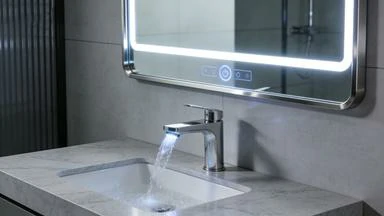
Commercial vanity mirrors are specified as part of a controlled wet-area interior system, with defined duty cycle, safety outcomes, and electrical coordination. The procurement baseline should treat mirrors as permanently installed building elements subject to site humidity, cleaning regimes, user impact risk, and local electrical inspection practices. In multi-unit delivery, consistency of optical quality, lighting uniformity (for illuminated models), and dimensional repeatability across production lots typically carries more operational value than aesthetic variation.
Commercial vs. residential mirror requirements (risk, duty cycle, liability)
Project-grade bathroom vanity mirrors differ from residential products in three practical ways: (1) predictable compliance evidence for glass and electrical safety; (2) corrosion resistance engineered for daily condensation and frequent cleaning; and (3) mounting methods designed for tamper resistance and repeated service access in occupied buildings. Where a residential mirror may rely on basic edge protection and non-listed electronics, a commercial specification commonly requires safety glazing behavior (or safety-backing film), defined ingress protection for wet-area placement, and documented electrical listings for illuminated and smart units.
Risk evaluation should include: shatter hazard potential in public washrooms, liability exposure from electrical faults in humid environments, and maintenance burden if LED drivers, controls, or defoggers are not serviceable without removing the full assembly.
Project submittals package: drawings, cut sheets, test reports, certificates
Mirror submittals should be verifiable system definitions, not catalog excerpts—critical for commercial projects matching commercial grade bathroom faucets specifications.
A complete package includes dimensioned elevation and section drawings, detailing mirror thickness, mounting points and wire exit location, aligned with heavy duty faucets installation needs.
Cut sheets must list glass construction, IP rating (for illuminated/smart models), LED parameters and control type, consistent with water-saving commercial taps system standards.
Safety compliance evidence (glass safety references, electrical listings) and corrosion/humidity test reports are required, matching lead-free faucets compliance requirements.
Packaging specifications (corner protection, crate type) for multi-site distribution ensure mirrors and bulk touchless hotel faucets arrive intact.
Stakeholder coordination: procurement, design, MEP, GC, facilities
Effective coordination among five stakeholders is key to ensuring mirror compatibility with commercial grade
bathroom faucets and overall bathroom systems.
Procurement locks in finish standards, MOQ/lead time and acceptance criteria, consistent with heavy duty faucets bulk procurement baselines.
Design aligns mirror proportions and lighting intent with touchless hotel faucets and water-saving commercial taps design aesthetics.
MEP confirms power routing and IP selection, supporting both illuminated mirrors and lead-free faucets operational needs.
General contractors verify wall build-ups to avoid rework for both mirror and commercial faucet installation.
Facilities teams confirm serviceability and spare parts plans, aligned with long-term maintenance of mirrors and bulk commercial faucets.
Mirror schedule template (type, size, zone, voltage, IP)
A mirror schedule reduces re-quotes by forcing early decisions on electrical and wet-zone constraints.
|
Field
|
Example entries (project-defined)
|
Notes for specification
|
|
Mirror ID
|
M-101, M-102
|
Align with room/vanity schedule
|
|
Location
|
Guest bath, public WC
|
Drives tamper and safety needs
|
|
Type
|
Non-illuminated / illuminated / smart
|
Smart = additional EMC scope
|
|
Overall size (W×H)
|
600×800 mm; 900×900 mm
|
Tie to vanity module width
|
|
Glass thickness
|
5 mm / 6 mm / 8 mm
|
Weight and impact trade-offs
|
|
Glass safety
|
Tempered / laminated / safety-backing film
|
Select per risk and code
|
|
Edge finish
|
Seamed / polished / beveled
|
Impacts corrosion and handling
|
|
Frame/enclosure
|
Frameless / metal frame / enclosed backbox
|
Drives depth + IP strategy
|
|
Wet-area zone
|
Zone 2 / shower-proximate
|
Guides IP selection
|
|
IP rating
|
IP44 / IP65
|
Define minimum acceptable
|
|
Voltage/frequency
|
110–120V 60Hz / 220–240V 50–60Hz
|
Avoid site adapters
|
|
Lighting
|
Front-lit / backlit; lumen target
|
Define uniformity expectations
|
|
Controls
|
Touch sensor / mechanical switch / occupancy relay input
|
Reliability + cleaning impacts
|
|
Defogger
|
Yes/no; coverage %
|
Specify duty cycle assumptions
|
|
Certifications
|
Electrical listing + restricted substances
|
Region-specific deliverables
|
Performance and Materials Engineering (Commercial Grade)
Glass selection: 5–8 mm float, tempered/laminated, safety-backing film
Commercial vanity mirrors commonly use 5–8 mm float glass, chosen for robustness—complementary to the durability of commercial grade bathroom faucets.
Glass thickness impacts impact resistance, optical flatness, anchor loading and packaging yield, just as heavy duty faucets rely on thickness for longevity.
Explicit safety strategies are required: tempered glass enhances impact performance, laminated glass ensures post-breakage retention, and safety-backing film reduces fragment fallout, especially for large mirrors in spaces with touchless hotel faucets.
Public, healthcare or high-vandalism projects should use safety backing as a baseline, matching the safety standards of lead-free faucets.
Silvering system: copper-free silver mirror, edge sealing, anti-corrosion
Bathroom humidity causes corrosion at mirror edges; copper-free silvering reduces this risk, similar to how water-saving commercial taps resist corrosion.
Commercial specs must include copper-free construction, thorough edge sealing to block moisture, and chemical-resistant back coatings compatible with facility cleaners.
For aggressive disinfectants, request chemical resistance statements, aligning with the durability requirements of bulk commercial faucets.
Frame and enclosure materials: stainless/aluminum, powder coat, salt-spray readiness.
Frame and enclosure materials: stainless/aluminum, powder coat, salt-spray readiness
Framed/illuminated mirror enclosures act as wet-area electrical housings, with materials chosen for corrosion resistance—matching lead-free faucets’ anti-corrosion design.
Stainless steel works well in coastal/high-cleaning areas, while aluminum (with proper coatings) reduces weight, ideal for large mirrors paired with heavy duty faucets.
Powder coating should prioritize performance over appearance; coastal projects need salt-spray validation, consistent with touchless hotel faucets’ harsh-environment durability.
Materials/performance comparison table (humidity, corrosion, impact)
|
Attribute
|
Frameless mirror (sealed edge)
|
Metal-framed mirror
|
Enclosed illuminated mirror (backbox)
|
|
Humidity tolerance
|
High if edge sealing is robust; edge is critical failure point
|
High; frame can protect edges if drainage/venting is managed
|
High; enclosure can isolate electronics; condensation management required
|
|
Corrosion risk
|
Medium–High at edges if sealing is inadequate
|
Medium; depends on frame alloy/coating and fasteners
|
Medium; depends on enclosure coating and penetrations
|
|
Impact and safety
|
Depends on glass type + safety backing; edges exposed
|
Improved edge protection; can add tamper resistance
|
Typically best tamper resistance; heavier and deeper
|
|
Cleaning compatibility
|
High; fewer crevices
|
Medium; joints can trap residue
|
Medium; vents and seams must be cleanable
|
|
Dimensional stability
|
High; low complexity
|
High; requires frame tolerance control
|
Requires enclosure flatness control to avoid mirror stress
|
Electrical, Lighting, and Environmental Specifications (Illuminated Mirrors)
Illuminated and smart mirror models shift the specification center from glass alone to an integrated electrical assembly. The performance target should be defined in measurable terms: light quality, uniformity, electrical input, protection rating, and service strategy.
LED performance: CRI 90+ targets, CCT 4000–6000K, lumen output and uniformity
For hotel vanity mirrors with lights and other commercial grooming/task contexts, CRI 90+ is a typical baseline to reduce color distortion in skin tones and finishes. Correlated color temperature (CCT) is often specified in the 4000–6000K range depending on design intent and adjacent lighting (downlights, sconces). Specify CCT tolerance (e.g., MacAdam ellipse/SDCM where applicable) when visual consistency across rooms is critical.
Uniformity should be treated as a requirement, not an assumption. For front-lit designs, address glare control and shadow reduction; for backlit designs, define perimeter halo consistency and acceptable hotspotting limits. Procurement should request photometric descriptions or test data where the mirror is the primary task light at the vanity.
Electrical design: 110–120V / 220–240V, drivers, load planning, serviceability
International commercial projects (paired with commercial grade bathroom faucets) often require dual voltage (110–120V/220–240V) or region-specific SKUs for mirrors.
Early alignment on voltage/frequency avoids late driver changes and re-testing, which also applies to bulk heavy duty faucets electrical specifications.
Specify input voltage, driver type/accessibility, total wattage for load planning, and cable exit location/connection method (hardwired or plug-in).
Serviceability is critical—sealed drivers/control boards lead to full-unit replacement, similar to maintenance risks with touchless hotel faucets.
Defogger specification: heating pad watt density, coverage, duty cycle, controls
Defoggers should be defined by heat output and coverage, not generic labels, to align with commercial bathroom standards including water-saving commercial taps.
Key parameters include heating pad watt density, coverage area (aligned with user sightlines), and duty cycle for peak occupancy periods.
Control integration (independent switch, shared lighting, building control) and timer defaults impact energy use, like lead-free faucets’ efficiency requirements.
EMC/EMI considerations for smart features (Bluetooth) and FCC compliance triggers
Wholesale smart mirrors (paired with commercial grade bathroom faucets) often have touch controls and wireless features requiring EMC/EMI management.
Confirm target market radio compliance (FCC for US, CE for EU), shielding/grounding in metal enclosures, and wiring separation.
Document performance under bathroom electrical noise to avoid nuisance behavior, ensuring compatibility with bulk commercial faucet systems.
Codes, Standards, and Certifications (Region-Ready Compliance)
Regional compliance is the cornerstone of commercial vanity mirror specification, requiring alignment with global industry standards and local regulatory requirements for wet-area safety, glass performance and electrical certification.
Wet-area zoning and ingress protection: IEC 60529 IP44/IP65 selection logic
Ingress protection selection should match location risk, not marketing convention. A common baseline is IP44 for vanity locations exposed to splashing (typical washbasin zones). Where mirrors are shower-proximate, exposed to high spray or direct water jets in cleaning, IP65 (or higher as project-defined) becomes a defensible requirement.
Procurement should require the IP rating to apply to the complete assembled product (including cable entries and control interfaces), not only to internal LED strips.
Glass safety compliance: ANSI Z97.1, CPSC 16 CFR 1201, EN 12150/EN 14179 references
Glass safety requirements vary by region and application. Submittals should clearly state which standard the supplied construction aligns with: North America: safety glazing references commonly include ANSI Z97.1 and CPSC 16 CFR 1201, or Europe/UK and aligned markets: EN 12150 (thermally toughened safety glass) and EN 14179 (heat soaked thermally toughened safety glass) are common references when tempered safety performance is specified.
Where a safety-backing film is used rather than tempered/laminated glass, define the performance intent (fragment retention) and request test evidence suitable for owner and authority review.
Electrical listing/marking: UL/ETL, CE, RoHS; documentation expectations for submittals
Illuminated mirrors must have region-appropriate electrical safety listings/markings, consistent with commercial grade bathroom faucets’ compliance standards.
Required documentation includes electrical safety evidence—UL/ETL for North America, CE for EU—matching lead-free faucets’ regional compliance needs.
Restricted substances documentation (e.g., RoHS declarations) and wiring diagrams/rated load statements are also necessary for MEP coordination.
For smart/wireless models, include applicable radio compliance documentation, aligned with bulk touchless hotel faucets’ regulatory requirements.
Code authority references: NEC/GFCI coordination, local AHJ acceptance pathways
In jurisdictions adopting the National Electrical Code, coordination items commonly include GFCI protection strategy and connection method. Regardless of region, align early with the authority having jurisdiction (AHJ) expectations for field inspection: labeling visibility after installation, access to junction boxes, and acceptable connection methods in wet areas. From a project-risk standpoint, it is safer to assume inspectors will require clear product markings, accessible electrical terminations, and documented listings consistent with the installed configuration.
System Compatibility and Integration with Vanity Assemblies
Seamless integration of commercial vanity mirrors with vanity assemblies hinges on precise dimensional, mounting and electrical coordination—ensuring alignment with faucets, MEP systems and accessibility standards for safe, functional commercial bath spaces.
Dimensional coordination: mirror width-to-vanity alignment, sightlines, ADA reach considerations
Mirror sizing should be tied to vanity module widths, faucet placement, and user sightlines rather than selected as an isolated decorative element. Common project logic aligns mirror width to the vanity width (or slightly narrower to protect edges from impact). For multi-unit standardization, define a limited set of mirror widths that map cleanly to the vanity series.
Where accessibility requirements apply, coordinate mounting height and reflective area with applicable accessibility standards and owner criteria. The mirror’s illuminated perimeter and control locations should remain reachable without compromising electrical zone/IP requirements.
Mounting engineering: Z-bar, security fixings, wall build-ups, load ratings and anchors
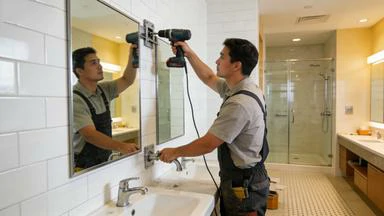
Professional mirror mounting should be defined as an engineered interface, consistent with the installation standards of commercial grade bathroom faucets.
Bar/cleat systems enable repeatable leveling and distributed load, while security fixings prevent theft and tampering in public spaces with bulk heavy duty faucets.
Wall build-up assumptions must account for tile thickness, backer board and waterproofing layers—factors that also impact touchless hotel faucets installation.
Load ratings depend on mirror mass and minimum anchor pull-out performance, based on wall substrate, similar to load requirements for water-saving commercial taps and lead-free faucets.
Avoid leaving anchor selection to field interpretation without confirming the substrate and required ratings; this is a recurring source of failures and rework.
Interfaces: outlets, junction boxes, access panels, and concealed wiring routes
For illuminated and smart mirrors, the electrical interface zone behind or adjacent to the mirror must be clearly defined, consistent with commercial grade bathroom faucets’ electrical interface standards.
Specify junction box location tolerances relative to mirror centerlines, ensuring alignment with bulk heavy duty faucets’ electrical layout requirements.
Define the minimum cavity depth behind enclosed mirrors to accommodate wiring bends and strain relief, matching the installation precision of touchless hotel faucets.
Outline access requirements for serviceable drivers/controls, identifying how to access them without damaging finishes—critical for long-term maintenance like that of water-saving commercial taps.
Ensure separation of wet-area waterproofing from electrical penetrations using defined gaskets or sealed entries, aligning with lead-free faucets’ wet-area safety standards.
Elevation/section diagram—mirror/vanity/lighting/MEP relationship
A typical coordination section (for submittals) must clearly outline the relationship between mirrors, vanities, lighting and MEP systems, aligned with commercial grade bathroom faucets’ layout standards.
The mirror should be centered to the vanity, with its width matching the vanity module within project tolerances—consistent with how bulk heavy duty faucets align to vanity layouts.
Electrical junction boxes must be located in the defined “service zone” behind the mirror, offset to avoid mounting cleats, similar to touchless hotel faucets’ electrical junction placement.
Concealed cable routes enter the enclosure via sealed grommets, with drip loop management as required by local practice—matching water-saving commercial taps’ wet-area wiring standards.
For back-lit mirrors, define wall clearance for light wash to avoid back-splash trim interference; for defoggers, show pad location and keep it clear of mounting hardware to prevent issues, aligned with lead-free faucets’ installation precision.
Manufacturing Quality, Validation, and Traceability
Robust manufacturing quality, rigorous validation testing and full lot traceability ensure consistent performance and compliance of commercial vanity mirrors across multi-site B2B projects.
Quality system requirements: ISO 9001 controls, incoming inspection, in-process checks
For wholesale mirrors supplied to multi-site projects, quality management is as critical as design—consistent with commercial grade bathroom faucets’ manufacturing standards.
ISO 9001-aligned controls include incoming inspection for glass and electronic components, in-process checks for silvering and edge sealing, and final optical/lighting inspections.
Procurement should request documented inspection points and defect classification, aligned with project AQL and bulk heavy duty faucets’ quality criteria.
Reliability targets: LED life (e.g., L70), driver MTBF, defogger endurance test criteria
Reliability claims must be engineering-based and tied to test methods, matching the durability standards of touchless hotel faucets.
Specify LED L70 lifetime, driver MTBF, and defogger endurance cycling tests, with thermal stability limits to ensure user comfort.
For hospitality projects, thermal design margins and driver derating are key—similar to water-saving commercial taps’ peak-use performance requirements.
Moisture and corrosion testing: humidity cycling, salt-spray methods, pass/fail thresholds
Moisture validation should reflect real bathroom conditions, with testing aligned to lead-free faucets’ anti-corrosion validation standards.
Include humidity cycling, salt-spray testing (for coastal/aggressive cleaning areas), and clear pass/fail criteria for edge, coating, and control performance.
Lot traceability and change control: glass batches, drivers, LEDs, coating runs
Traceability protects multi-phase rollouts, requiring lot/serial tracking for glass, silvering, drivers, and LEDs—consistent with bulk commercial faucets’ traceability requirements.
Change control notifications are mandatory for component substitutions that impact certification or performance, like those for commercial grade bathroom faucets.
Sourcing, Commercial Terms, and RFQ Evaluation Criteria
Robust manufacturing quality, rigorous validation testing and full lot traceability ensure consistent performance and compliance of commercial vanity mirrors across multi-site B2B projects.
RFQ inputs that prevent re-quotes: sizes, zones, IP, voltage, controls, edge/finish, packaging
RFQs for wholesale and illuminated mirrors must include non-negotiable technical fields to avoid pricing resets, aligned with heavy duty faucets bulk RFQ standards.
Key inputs include mirror sizes, wet-area IP ratings, voltage requirements, lighting/control specs, glass safety, and packaging—matching touchless hotel faucets’ RFQ criteria.
MOQ and lead time logic: stock vs. custom, multi-site rollouts, schedule risk management
MOQs and lead times depend on standardization: stock programs reduce risk for phased projects, while custom mirrors require longer validation—similar to water-saving commercial taps’ sourcing logic.
Multi-site rollouts need a spares strategy aligned with standardized SKUs, ensuring minimal disruption like that of lead-free faucets’ maintenance plans.
Packaging and logistics: drop-test expectations, crate design, container yield assumptions
Mirror packaging is critical for transit protection; procurement should request drop-test validation, edge protection, and crate design—consistent with bulk commercial faucets’ packaging requirements.
Coastal projects need moisture barriers for sea freight, and palletization assumptions support landed-cost modeling, aligned with commercial grade bathroom faucets’ logistics standards.
Acceptance criteria at receiving: AQL, visual defects, dimensional tolerances, documentation checklist
Receiving criteria reduce disputes, including dimensional tolerances, visual defect limits, functional checks for smart models, and a complete documentation checklist.
These criteria ensure mirrors meet project standards, just as inspection protocols verify lead-free faucets and other commercial bathroom fixtures.
Application Scenarios and Decision Frameworks (Project Use)
Align commercial vanity mirror specs to project use cases with tailored decision frameworks for hospitality, healthcare and multi-family housing.
Hospitality: guest bath vanity mirrors (IP44+, CRI 90+, defogger prioritization)
Hospitality projects typically optimize for consistent guest experience, rapid maintenance response, and uniform appearance across room types. Common specification baselines include IP44+ for vanity locations, CRI 90+ lighting, CCT aligned with the room lighting concept, and defoggers sized for central visibility. If mirrors are the primary grooming light, photometric consistency and glare control should be prioritized over feature count.
Energy efficiency should be evaluated at the system level: LED wattage, driver efficiency, dimming strategy, and defogger timers have direct operational impact across hundreds of rooms.
Healthcare and public facilities: safety glazing, tamper resistance, cleanability constraints
These environments tend to push requirements toward safety glazing behavior, fragment retention, and tamper-resistant mounting. Touch interfaces can be acceptable, but should be specified with cleaning compatibility, sealed surfaces, and proven resistance to false triggering under moisture. Cleaning protocols often include strong disinfectants; request chemical compatibility documentation for coatings, seals, and touch surfaces.
Multi-family and student housing: durability, standardization, spares strategy
Here the value typically comes from standardization and durability: limiting mirror SKUs across unit types, using repeatable mounting patterns, and selecting control systems with low failure rates and straightforward replacement. For illuminated models, define service access and driver replacement method to reduce unit downtime.
Selection matrix (application → specs: IP, glass, mounting, lighting, certifications)
|
Applica-tion
|
IP target
|
Glass
& safety
|
Mount-ing
|
Lighting
|
Certifications
|
|
Hospitality guest baths
|
IP44 (vanity), IP65 if shower-proximate
|
5–6 mm; safety backing or tempered per risk
|
Cleat/Z-bar + secure fasteners
|
CRI 90+; 4000–6000K; uniformity defined
|
Electrical listing, IP evidence, photometric parameters
|
|
Public wash-rooms
|
IP44+; higher if exposed cleaning jets
|
Tempered/laminated or safety-backed
|
Tamper-resistant, security fixings
|
Glare controll-ed; robust controls
|
Safety glazing references, vandal resistance notes, service plan
|
|
Healthcare
|
IP44+; project-defined
|
Safety-focused (laminated or robust retention)
|
Security mount-ing+clean-able edges
|
High uni-formity; avoid flicker
|
Chemical compatibility, safety glazing, electrical listing
|
|
Multi-family/ student housing
|
IP44 typical
|
5–6 mm; safety backing as risk control
|
Repeat-able mount-ing geo-metry
|
Efficient LED; simple controls
|
Standardized SKUs, spares, traceability
|
PAA: Project and Specification Questions (Professional)
Answer critical professional questions about commercial vanity mirror projects, offering guidance on smart features, installation, lighting selection and wireless integration for B2B use.
What features should a smart hotel mirror have?
For hospitality use, smart features should be limited to functions that reduce operational load and improve consistency: sealed touch controls, predictable dimming behavior, timer-based defogger control, and stable lighting output (CRI/CCT targets). If wireless connectivity is required, include documented radio compliance for the region, plus EMC/EMI design evidence to prevent nuisance behavior in dense multi-room deployments.
Are touch sensors reliable for public use?
Touch sensor mirrors can be reliable when the touch interface is sealed, moisture-tolerant, and validated under humidity cycling. Reliability is less about the sensor type and more about enclosure sealing, grounding/shielding, and control firmware behavior under wet hands and cleaning. In high-abuse environments, procurement should specify tamper resistance, a defined response behavior under continuous activation, and serviceability of the control module.
How to choose between front-lit and backlit?
Selection is typically driven by task-lighting requirement and glare control. Front-lit mirrors can provide better facial illumination at the vanity and reduce shadows, but require attention to diffuser design and glare. Backlit mirrors support ambient wall wash and design uniformity but may not meet task-lighting needs alone unless lumen output and room lighting are coordinated. For multi-unit projects, define performance targets (CRI, CCT, uniformity, glare limits) rather than choosing purely by appearance.
Are LED mirrors energy efficient for hotels?
LED mirrors are generally efficient compared with legacy light sources, but the energy profile depends on wattage, driver efficiency, dimming strategy, and defogger use. In hotel applications, defogger timers and control defaults often have greater energy impact than the LED strip itself when deployed at scale. Specify maximum wattage, standby power behavior, and timer defaults to make energy performance predictable.
What are the installation requirements for LED mirrors?
At a planning level, LED mirrors require coordinated junction box placement, defined cable exit zones, and confirmation of wall substrate/backing adequate for mirror mass and mounting method. Wet-area zoning should be set early to select the correct IP rating, and electrical listing/marking must match the connection method used on site. Where serviceability is required, include an access strategy for drivers and controls without damaging finishes.
Can hotel mirrors be integrated with Bluetooth?
They can be, but wireless features introduce additional compliance and performance considerations. Specify radio compliance for the destination market, confirm EMC design to avoid interference and flicker, and define operational controls suitable for hospitality (pairing behavior, reset method, and privacy/security expectations). In many projects, restricting wireless functionality or centralizing it outside the bathroom reduces commissioning and support load.
FAQs
What makes a faucet "commercial grade"?
Commercial grade bathroom faucets meet rigorous durability, compliance, and serviceability standards for high-traffic settings. They include heavy duty faucets bulk options, resist corrosion, match lead-free faucets’ safety standards, and suit multi-site deployments—similar to B2B bathroom vanity mirrors.
Are touchless faucets worth it for hotels?
Yes, touchless hotel faucets are cost-effective for hotels. They boost hygiene, reduce water waste (with water-saving commercial taps), minimize wear, and align with commercial grade bathroom faucets’ longevity—complementing B2B bathroom vanity mirrors.
How to reduce water consumption in hotels?
Install water-saving commercial taps and touchless hotel faucets, pair with low-flow commercial grade bathroom faucets and lead-free faucets, and choose heavy duty faucets bulk options. Regular maintenance and coordination with B2B bathroom vanity mirrors also cut waste.
What are the ADA requirements for faucets?
ADA requirements for commercial faucets (including touchless hotel faucets and lead-free faucets) include easy controls, reachable design, and water efficiency (matching water-saving commercial taps)—aligning with B2B bathroom vanity mirrors’ accessible standards.
How to prevent limescale buildup in faucets?
Prevent limescale in heavy duty faucets bulk, touchless hotel faucets, and lead-free faucets with regular maintenance, mild cleaners, and anti-limescale commercial grade bathroom faucets—similar to B2B bathroom vanity mirrors’ upkeep.
What is the lifespan of a commercial faucet?
Commercial grade bathroom faucets (heavy duty faucets bulk, touchless hotel faucets, lead-free faucets) last 10–15 years. Water-saving commercial taps last longer with maintenance, matching B2B bathroom vanity mirrors’ durability.
Which IP rating is typically specified for vanity mirror locations in wet areas?
IP44 is standard for splashing; IP65 for shower-proximate areas. This aligns with commercial grade bathroom faucets, touchless hotel faucets, and lead-free faucets’ wet-area safety standards.
Which certifications are typically required for illuminated vanity mirrors in North America vs. EU markets?
North America requires UL/ETL and glass safety; EU requires CE/RoHS. These match commercial grade bathroom faucets, lead-free faucets, and water-saving commercial taps’ compliance standards.
When should tempered or laminated safety glass be specified for hotel and public washrooms?
Specify tempered/laminated glass for high-impact, public areas—aligning with commercial grade bathroom faucets and heavy duty faucets bulk options’ safety priorities.
What CRI and CCT ranges are commonly used for commercial grooming/task lighting at vanities?
CRI 90+ and CCT 4000–6000K are standard, ensuring B2B bathroom vanity mirrors complement commercial grade bathroom faucets and touchless hotel faucets.
What documentation should be included in a mirror submittal to satisfy inspection and owner standards?
Include drawings, cut sheets, IP/electrical ratings, safety references, and test reports—matching commercial grade bathroom faucets, lead-free faucets, and water-saving commercial taps’ documentation requirements.
References